Samarkand is a city of mausoleums, mosques, mosaics, and a kind of bread you cannot break with your hands. It is also a city where I once watched eight grown men ride a single bicycle in eight different directions, and I am still not entirely sure I saw it correctly. We will get to that. For now: the blue.
The blue is in the tile. The tile covers three buildings around a central square — the Registan, you can write that down — and at six in the morning, before the tour groups arrive, the square belongs to whoever is awake. By 7:30 the buses will be there. For ninety minutes before that, you have the centre of the world to yourself. The light moves. The colour moves with it. The cobalt — kobalt, the restorers call it: a word that arrived in Uzbek through Russian, through German, originally from somewhere Persian — sits differently against grey morning light than against full sun.
The first building to catch the dawn is the Sher-Dor, the one on the east side, with the famous lions on its tympanum — the tigers, locals will tell you, though zoologically they are something between a lion and a leopard. They also have suns rising out of their backs, which complicates further classification. Lions, even ambiguous lions, are not strictly Islamic iconography — part of why they're famous. Then the Tilya-Kori, the gilded one. And Ulugh Beg, the oldest, whose façade was already four centuries old when the others arrived to keep it company.
The first joggers come. Two old men sweep the steps. A guard with his hands behind his back.
Uzbekistan opened in 2018. That's when visa-free entry began for most Western travellers, after twenty-seven years of effective closure to anyone who wasn't Uzbek or in some kind of trouble for being there. The country had been the personal property of Islam Karimov, whose government held power from 1991 until his death in 2016. Karimov ran a country with no protest, no opposition press, and approximately zero tourists, and he kept it that way for a quarter-century with the patient discipline of someone tending a fire.
Shavkat Mirziyoyev took over in late 2016 and the changes started arriving in months, not years. Visa-free travel in 2018. Convertible currency the same year. Direct flights from Dubai, Istanbul, Frankfurt by 2019. A new Samarkand International Airport in 2022. A high-speed train that didn't exist before 2011 now runs Tashkent–Samarkand–Bukhara four times daily. The country has done in seven years what neighbouring countries took thirty to do — under leadership the country at large does not pretend is liberal democracy in the Western sense, but is, by every account, materially less of a fire.
The window for visiting Samarkand right now is short. In ten years the city will have international hotel chains and the same set of restaurants you can find in Dubai. Right now it has the tilework, the mausoleums, kimchi at every table for reasons I will explain, and a small cautious tourism economy that still feels like a country meeting itself.
Samarkand is, among other things, a city of the dead. I walked five mausoleums in five days, which is fewer than the standard tour lists and more than is healthy for the spirit.
They each have a personality. Rukhobod is the honest one — a low brick dome, no decoration, fourteenth-century, a Sufi sheikh underneath. The kind of tomb that suggests the man inside would have considered the others ostentatious. Gur-i-Amir, by contrast, is Timur's, and Timur — who in life conquered most of the known world and reportedly built towers of skulls to mark his progress — is now lying under a fluted turquoise dome and a slab of nephrite the colour of jade gravel. The conqueror has decided the afterlife should be done in good taste. Hazrat Khizr is the view. White-walled, timber-vaulted, on a low hill above the old town. From its terrace you see the whole city below: domes and apartment blocks, gardens and bus stops, all visible at once. Bibi-Khanym is the wife. Specifically, she is the mosque Timur built for his Chinese-born wife in the late fourteenth century: too large for the technology of its time, the largest mosque attempted in the Islamic world to that point, and which proved to be exactly that — too large. It collapsed. More than once. It has been half-restored and half-collapsed and half-restored again so many times that half-collapsed is now just its architectural identity.
And Shah-i-Zinda, the avenue of mausoleums north of the Registan, is its own register entirely.
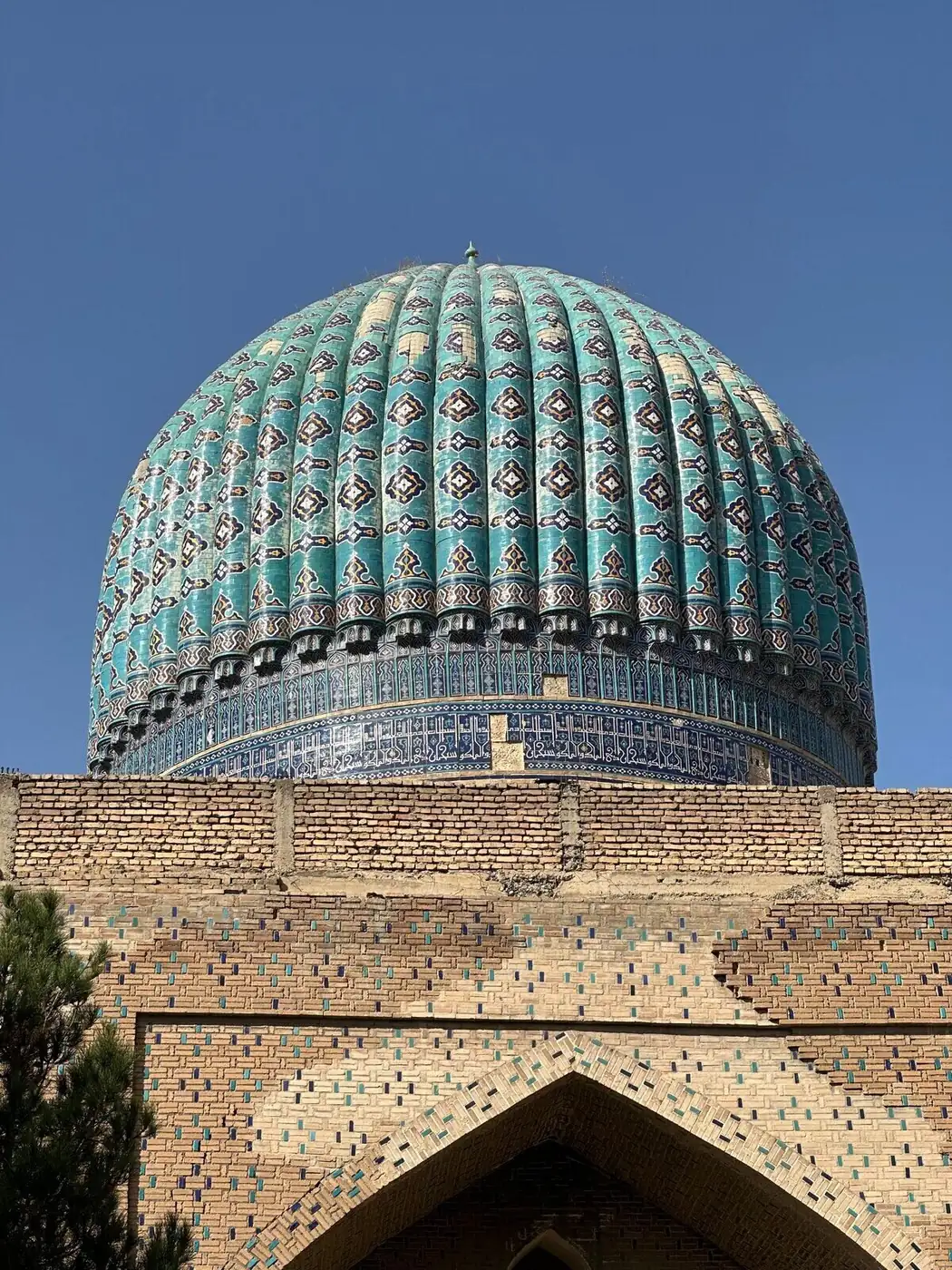
Shah-i-Zinda is a long corridor of fourteenth-century mausoleums for the Timurid elite and their relatives. Each chamber is faced in a different pattern of tilework. It is quieter than the Registan, and it is still in use — pilgrims come on Fridays, families on weekends — which makes the boundary between fourteenth-century devotion and twenty-first-century devotion less clear than it would be in a museum.
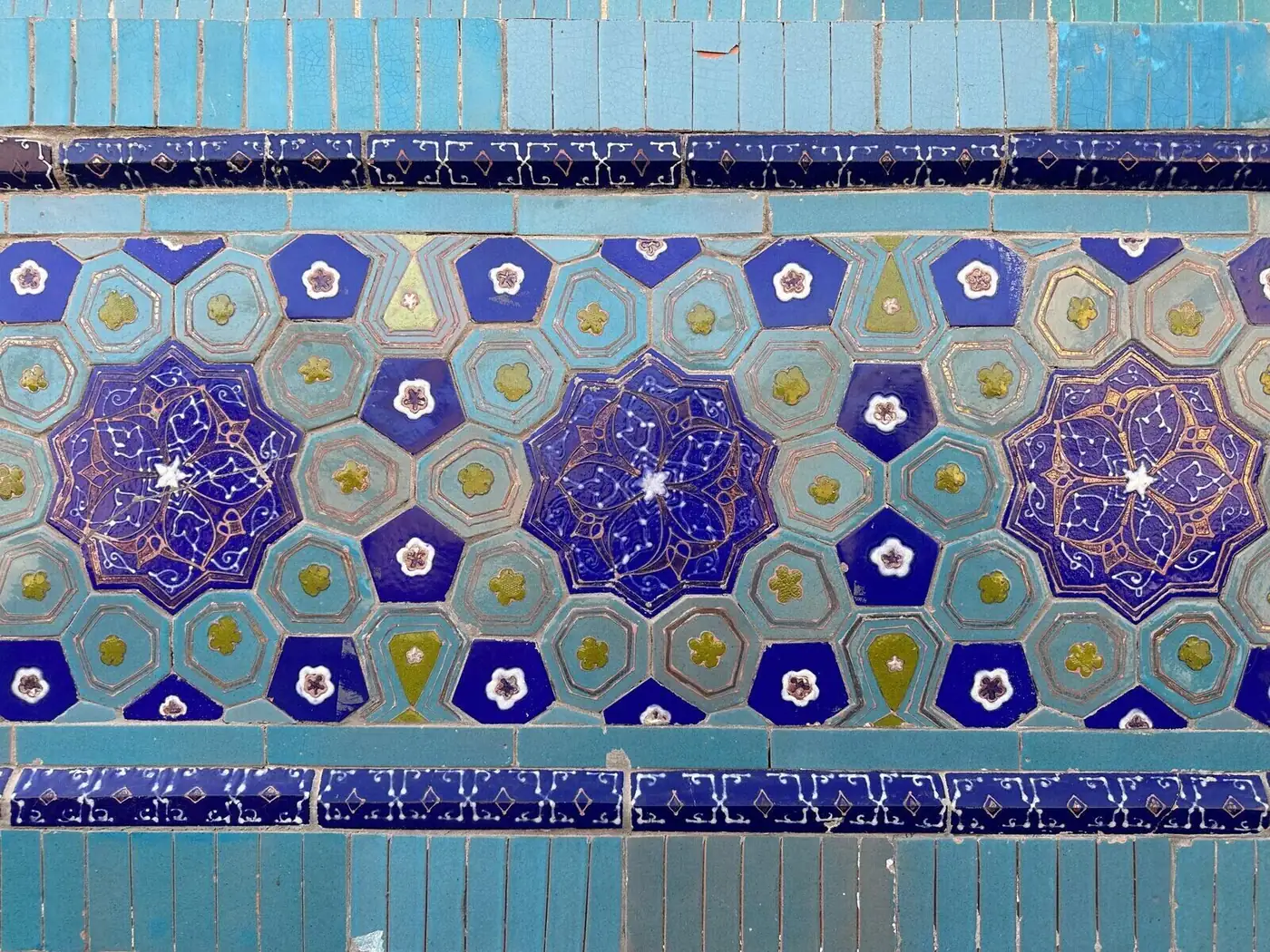
The tilework runs in colours the Registan doesn't reach. There is a turquoise that is exactly the colour of the inside of a Pacific reef. There is a green — for jannah, paradise — that has no equivalent in Western architecture. There are eight-pointed stars that are not stars at all but two interlocking squares, representing the union of earth and sky.
The cobalt has a passport. The deepest blues in the tilework come from lapis lazuli, ground and fired into a glaze, and lapis came almost exclusively from the mines of Sar-e-Sang in what is now north-eastern Afghanistan — the same mines that supplied Tutankhamun's death mask, Byzantine icons, and the robes of every Renaissance Mary you can name. The blue you are looking at on the walls of Shah-i-Zinda travelled six hundred kilometres north from those mines, by camel and donkey, was traded along the way, and was prepared in workshops that no longer exist by craftsmen whose names were not recorded. It moved further than most of the people in this city ever did.
The food, briefly, because it earns its own paragraph.
Uzbek cuisine has been receiving inputs from China to the east, Persia to the south-west, and Russia to the north for two thousand years and metabolising them into something distinctly itself. The national dish is plov — rice cooked with lamb, carrots, onions, cumin, garlic or barberries depending on which family you ask, served from a giant communal pan called a kazan. I had it three times in Samarkand, at three different establishments, and the differences between them were the kind of thing you'd argue about with friends for an evening.
The bread is non: round, scored, stamped with a small wooden tool called a chekich that prints a pattern of dots into the centre. There are two kinds. One is a chewy, crispy-on-the-outside loaf that, fresh from the tandoor, is among the best bread I have ever eaten in my life. The other is its older, harder cousin — flat, dense, rock-solid, baked to a durability that Central Asian families have used for centuries to keep bread for over a month. I held one in my hand and could not break it. It had the heft of a small tile. Looking at it I thought: this is bread that has been engineered for the same kind of survival as the people who eat it. Hardy. Long-lasting. Difficult to ruin.
The samsa is the Uzbek samosa — same Persian root, different evolution. The pastry is heavier than the Indian version, baked in a tandoor rather than fried, and the meat-and-onion filling is sealed in by a coat of mutton oil that the cook brushes on before baking. The result smells, depending on whether you grew up around mutton fat, either intoxicating or revolting. I was on the intoxicating side. The first one I bought from a street vendor near the Registan I ate standing up, and the second I bought twenty minutes later.
Then there were the things I had not expected. Avesta paxlava — Uzbek baklava — denser than its Levantine cousins, more honey than syrup, with crushed walnuts where the Greeks would put pistachios. A yogurt drink the colour of new snow that, served cold and slightly salted, is what every other yogurt drink I have had since has been compared to and lost. And anor juice — pomegranate, hand-pressed, served in a glass at room temperature, sweet and astringent and exactly as red as you would imagine. I drank it every day.
Around day three I started noticing something. There was kimchi. Everywhere. Not as a curiosity. As a side. With every meal. Plov and kimchi. Non and kimchi. Pomegranate juice and kimchi. I had assumed at first that I was finding it because I was looking for it — the way Asians abroad sometimes find each other in the lobbies of unrelated hotels — but no. It was on every Uzbek menu. The other tourists were eating it too, several without entirely knowing what it was.
The history, when I dug it up, was closer than you'd think. In 1937 Stalin deported the entire ethnic Korean population of the Soviet Far East — Koryo-saram, they call themselves — to Central Asia. They settled in what became Uzbekistan and Kazakhstan, and within two generations had invented an entirely new cuisine. Morkovcha, the carrot kimchi served at every table in Samarkand, was created here, by Koreans who couldn't get the cabbages they were used to and improvised with what the local fields grew. Korea is what kimchi is famous for. Central Asia is where the other half of it quietly lives, in carrot form, eaten daily by people who have, for the most part, no idea they're eating something invented by someone Stalin moved.
Walking back from Shah-i-Zinda one afternoon, I cut through a small park. The paths were laid in eight-pointed stars — the same geometric pattern that runs through the tilework, scaled up and reproduced in white gravel between flowerbeds. From the trees hung ornaments: small painted ceramic shapes, ribbons in saturated colours, brass lanterns. The whole grove looked decorated for a festival.
Through the trees I saw the festival. A wedding — the wedding, as far as that small park was concerned — was assembling. The bride was in white, which is a colour Western weddings have managed to claim as theirs, but never mind. The bridesmaids had decided to make up for the bride. They were in deep ruby, in turquoise, in apple green, in saffron — a colour spectrum that in any country less confident would have read as fancy dress and was, here, simply what people wore. The grandmothers were in headscarves the same saturated turquoise as the Gur-i-Amir dome. The grandfathers were in suits. The whole party assembled in a half-circle around the photographer, and the colours of the dresses against the white-gravel star paths and the green of the trees and the cobalt of the wedding canopy were enough to make me stop walking.
Later, walking the bulvar — the wide central boulevard that runs through new Samarkand — I saw why the wedding party had chosen the park. The bulvar at six in the evening is where the city is. Families with children. Couples on benches. Old men playing chess on stone tables with the boards painted directly into the stone. Teenagers in matching school uniforms, laughing too loud. The trees along the path were strung with lights. The fountains were on.
At one point a contraption rolled past that I am still not entirely sure I saw correctly. It was a bicycle, but circular — eight saddles arranged radially around a central hub, each with its own set of pedals, each rider facing outwards in a different direction, all of them pedalling in concert to make the thing go forwards. The riders were eight grown men, two of whom were clearly not enjoying themselves. The contraption was not fast. It was not, as far as I could tell, going anywhere in particular. Several children ran alongside it laughing. No-one on the bulvar reacted as though this were unusual. I stood for a moment with my mouth open.
The whole space was being shared, very visibly, by a country that has decided, in the last decade, that public space matters and that ordinary people get to use it — including, apparently, in formations of eight.
The Persian dutar, somewhere around the time the Silk Road was at its busiest, made some choices. Some of it went west. It became the European lute, the Italian mandolin, and eventually — after several more centuries of moving and intermarrying — the guitar. Some of it went east. It became the Chinese pipa, the Japanese biwa, the Korean bipa. And some of it stayed home, in Samarkand, where I came across the entire family standing upright behind glass somewhere between the bulvar and the old town: the tanbur, long-necked and gourd-bodied; the sato, a bowed cousin of the same; the dutar itself, two strings on a long pear-shaped body, the instrument of shepherds and city poets alike; the Azeri tor; and the qashqar rubob, large-bodied and fretted, named for the city of Kashgar four hundred kilometres east at the foot of the Tian Shan. They were the cousin who stayed home, never moved out, still has the original furniture.
I sat at a tea house on a side street one afternoon. The house had no interior, exactly — or rather, the interior was a shaded courtyard, and the seating was a wooden platform raised about eighteen inches off the ground, covered in carpets and bolster cushions, on which you took off your shoes and arranged yourself cross-legged. Tea was served from a pot in the middle of the platform; the non was torn and shared.
What struck me, an Asian sitting on someone else's elevated platform in the late afternoon shade, is that I had been here before. Not in Samarkand. But the platform-and-carpet configuration, the shared pot, the shoes-off-at-the-edge protocol — these are the same architecture as the ondol room in a Korean grandmother's house, the engawa of a Japanese summer porch, the elevated wooden platforms of Hokkien village tea shops. Central Asia and East Asia split a long time ago, but they kept the same idea about what social space looks like when you sit down to share something. Distant cousins, you might say, who haven't seen each other in a thousand years and who, when they meet again, recognise the furniture.
I am not going to write about Karimov's Uzbekistan in detail. There are people who lived through it whose accounts you should read instead. What I will say is that everyone I asked about the last decade gave me, unprompted, some version of the same line: we are doing better. They didn't volunteer the line because I asked. They volunteered it before I'd finished asking.
Whether the country is better by every measure a foreigner might count is not mine to settle in five hundred words. It is writing the next chapter. I was a guest at chapter four.
What I will say is that the Samarkand I walked is unrecognisable from the Samarkand a foreign traveller would have seen in 2010. The city is open. The young people are learning English. There are women guiding tours and women running bookshops and women at every level of the new tourism economy. The old square that I had to myself at six in the morning is being shared, very visibly, by a country deciding in real time how to host visitors.
On my last afternoon I climbed the hill at Hazrat Khizr and looked down at the city. The Bibi-Khanym dome to the south. The gold of Gur-i-Amir to the east. The faint blue smudge of the Registan beyond it. New apartment blocks. The bulvar. The trees of the park where the wedding had been. Somewhere down there, in a kitchen I had not seen, a Korean grandmother was teaching her granddaughter how to cut the carrots.
I had been here four days. I had walked the Registan three times and Shah-i-Zinda twice. I had eaten plov at three different establishments and could detect, after the third, the particular Samarkand variant that uses yellow carrots instead of orange. I had held bread that could survive a month and bread that did not survive an afternoon. I had watched a wedding in colours I do not have words for.
If you go: take the night train at least once. Walk the mausoleums in the order they were built — Rukhobod first, Bibi-Khanym last, Shah-i-Zinda whenever the light is right. Drink the pomegranate juice. Eat the samsa standing up. Try the kimchi. Eat the bread; don't try to break the bread. Sit on the platform at the tea house and let the afternoon take as long as it wants to. Watch the Registan at dawn, then come back at sunset, then come back at night when the floodlights are on and the tilework reads almost like neon. The blue at the centre of the world has been there for six hundred years. It is in better condition now than it has been in three of those centuries. The country watching over it is in a different position than it has ever been. The window is open. Right now is when you should come. (And if you see a circular bicycle: yes, that's a real thing. No, no-one knows why.)