The restaurant had no chairs. No tables. There was a long room with cushions running the length of three walls, and when I sat down the waiter brought a clear plastic sheet and laid it on the carpet in front of me, and on the sheet he laid the food. Pistachio kunafa, still warm, the cheese underneath stretching. Hummus the temperature of the room. Dates that tasted like they'd been pulled from a tree somewhere a few hours earlier. A small porcelain pot of cardamom coffee. He came back periodically to bring more.
I had no idea what to do with my legs.
This was Old Jeddah, in the second-to-last week of my trip, in a country that two years before would not have given me a tourist visa.
Saudi Arabia opened to general tourism in 2019. Before that, you could enter only as a Muslim pilgrim on Hajj or Umrah, or for business, or with a sponsor. The Vision 2030 reforms changed this — alongside a thousand other shifts that took the country, in five years, from one of the most closed places in the world to one of the most aggressively curating. I'd come because Jeddah is, historically, where this whole thing started.
For more than a thousand years, Jeddah was the port. Pilgrims arrived by ship, were processed here, then sent inland to Mecca and Medina, sixty kilometres east. The whole city was a logistics machine for arrival — caravanserais, goldsmiths, money changers, merchants — built on the coral stone you can still see in the walls of Old Jeddah, the historic district known as Al-Balad. The buildings there are the ones the ships saw first.
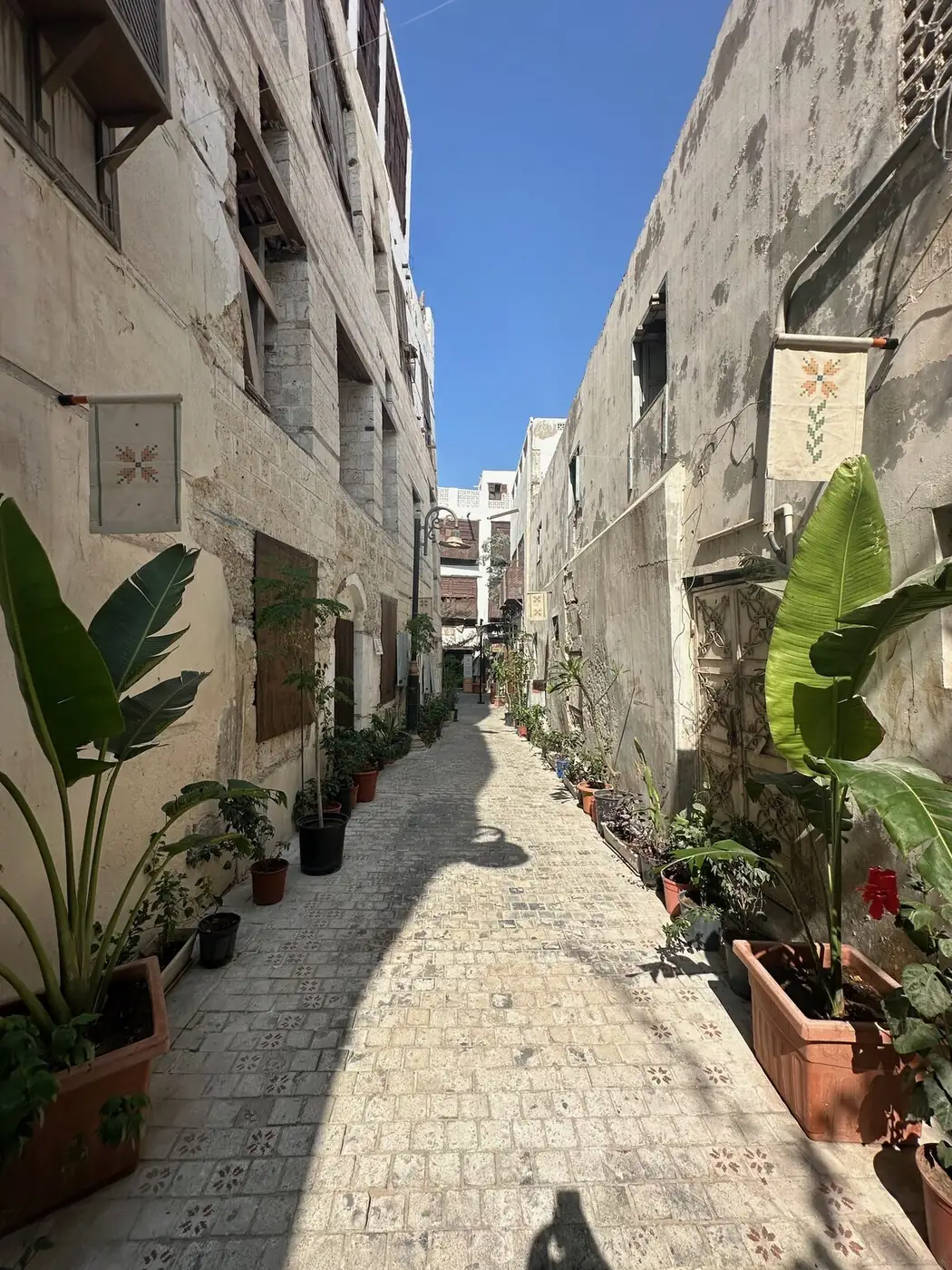
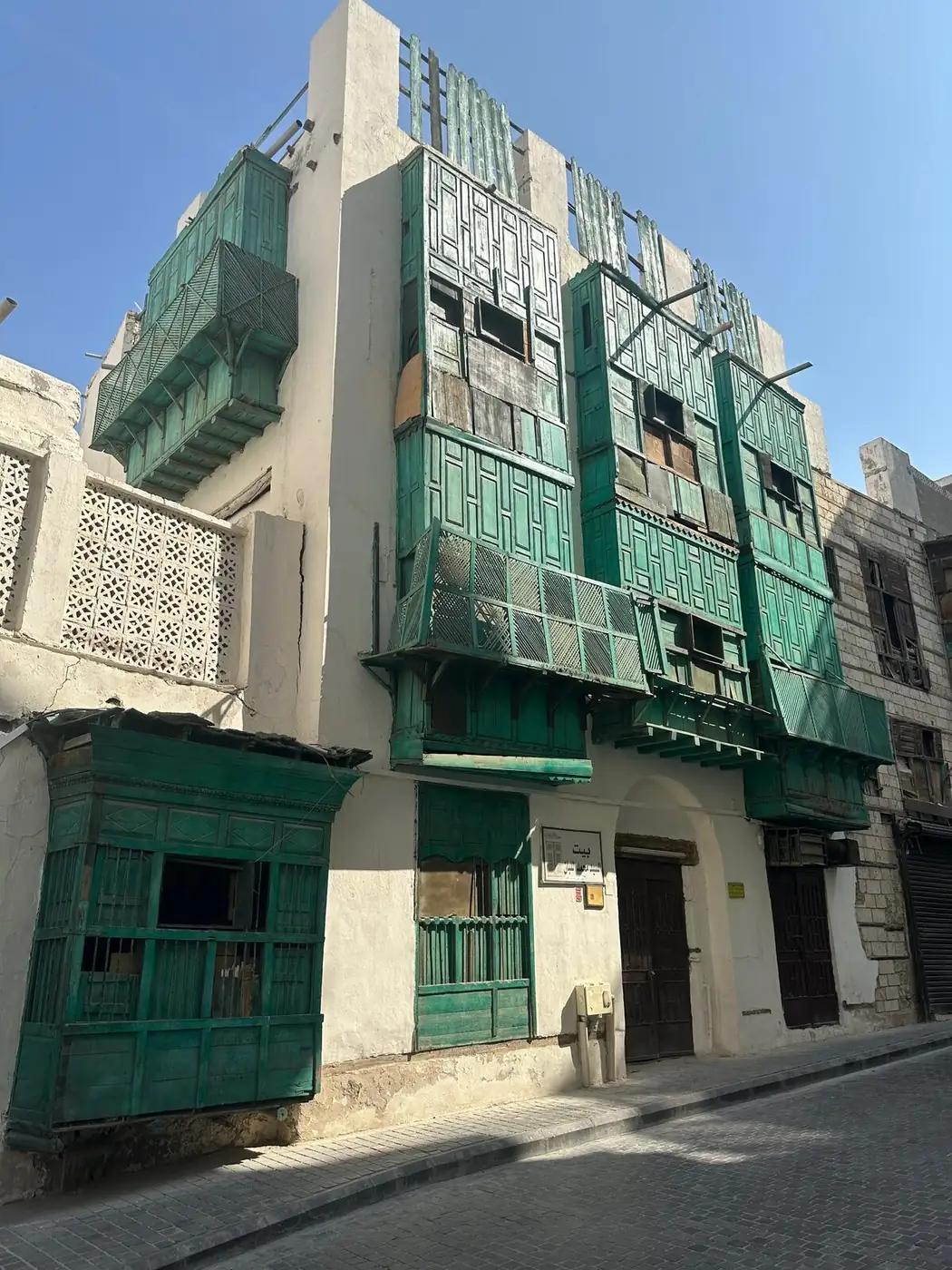
Al-Balad is being restored. Slowly. Some buildings are scaffolded; some are propped up by timbers; some are still mostly rubble. But you can see the bones — five-storey coral-stone houses with rawasheen, the carved wooden lattice balconies that let air through while keeping out the sun. Each rawasheen is unique. The wood is sometimes painted in faded turquoise or sienna; sometimes stripped to bare grain. Some are intact and being polished back to display, others tilted at improbable angles, the carved screens hanging by single nails.
The whole quarter has a particular green. Green as a hue for stone — coral, when it cures, gets a soft sea-glass cast — and green as the ambition of the restoration. The country wants this back.
Walking through Al-Balad in the afternoon, I passed a group of young men in matching uniforms standing in front of an old merchant's house. They were guides in training. The trainer, a man in his fifties with grey at his temples, saw me and waved me over.
"Please. Stop. Please." He was smiling. "These are my students. They are practicing. Would you let them practice on you?"
The students were nervous. The first one explained the carved doorway in front of us — a particular eighteenth-century merchant family, the patterns specific to that family's commission — in halting English. The trainer prompted him gently when he stuck. The second student took over. Another building, another family, another century. By the fifth student I was being introduced to the entire history of an Al-Balad block by a relay team of nineteen-year-olds whose English was improving as they went.
This happened to me three times in two days. The trainers were always kind. The students were always nervous. The trainer always thanked me afterwards for being patient.
I don't think I've ever been thanked for being a tourist before.
People in Jeddah were friendlier than I had any right to expect. Hijazi people — those native to the western coastal region around Jeddah and Medina — have always been more diverse and outward-looking than the rest of the country. The port saw merchants and pilgrims from East Africa, India, Persia, Egypt, the Levant, Indonesia, for centuries. The faces in Jeddah are this whole map.
I am Asian, and I look it. There weren't many Asian visitors in Jeddah when I went. A few people stopped to ask for photos — kids on a school trip, a young couple at the corniche, a boy of maybe ten who wanted me to high-five his uncle. Each of them said hello first. Each of them seemed delighted I was there.
This is also a country governed by a particular interpretation of Islamic law that asks women to dress modestly in public. Most of the women I saw in Jeddah wore the abaya — the long black robe — and headscarves. Many wore niqab. The dress code has been formally relaxed since 2019 (women are no longer required by law to wear the abaya in public), but practice has lagged the law, and the social code still holds in most places.
One evening on the corniche, a blonde tourist walked past in a tank top and shorts. She was visible at fifty metres in a way that made me realise how dressed everyone else was. Heads turned, but politely — not aggressively — and she walked through unbothered. I watched her go and thought about how sharply different countries hold the line on this, and how much the Saudi version has shifted in just a few years, and how strange it must be for a woman in her sixties to watch the rules of the public space move this fast.
I'm not going to pretend I know what to think about it. There's a way to write this scene that picks a side, and I'm not going to. The country is in the middle of becoming something, and the becoming isn't finished, and saying anything definitive about which version is the real one feels premature.
The change is on Saudi faces, not just on the law books. On the corniche one evening I watched a young Saudi couple walk the promenade — side by side, easy, neither married, no chaperone. Five years ago the religious police would have intervened. Earlier the same day a Saudi woman about my age had pulled up to the cafe next to mine in a small white sedan, driver's seat, alone, unhurried. She parked, ordered an iced latte, and stayed for an hour with a book. Saudi women have been allowed to drive only since 2018; she would have spent most of her adult life unable to. None of this was remarkable to her or to anyone who lives here. All of it was remarkable to anyone who hasn't been back since the country opened.
The food, briefly, because it earns its own paragraph.
Hijazi cuisine has been shaped by every trade route that touched it. I ate kabsa — spiced rice with lamb — at the cushion-room restaurant, my legs eventually figuring out what to do with themselves. I drank Jeddah coffee from a street vendor — a glass cup, very small, lightly cardamom, surprisingly bitter, served standing up at the curb. Hijaz coffee was sweeter, more familiar, served with a date on the side. There was a man near the souq selling sugar cane juice from a hand-cranked press — emerald green, sweet, served in a paper cup with ice. I drank three over four days.
Pistachio sweets stacked in glass cases. Octagonal trays of them. Prices in riyals. A man with a small pair of tongs handing them out one at a time, watching to see your reaction, smiling when you nodded.
Everywhere I went, someone offered me coffee. Not transactionally. In the way of a culture that takes hosting seriously. The shopkeeper at the rug place. The trainer with his students. The waiter at the cushion-room. The man at the door of a museum I didn't end up entering. I think I drank more coffee in four days in Jeddah than I had in any equivalent period of my life.
The coffee comes with a choreography. The pourer holds the dallah — the long-spouted brass pot — in the left hand, and pours with the right into a tiny handleless cup called a finjan. Filled no more than a third. The eldest is served first, then around in sequence. You hold the cup with your right hand. When you've had enough, you give the cup a slight shake side-to-side, and the pouring stops. Otherwise it doesn't. No one explains any of this.
Hong Kongers, when someone pours their tea, tap the table twice with two fingers — a wordless thank-you that lives entirely in the hand. Saudi qahwa runs on the same principle. The whole acknowledgement in one gesture. Across cultures that take hosting seriously, you find these little syntaxes — older than the languages around them, and far more reliable.

On the last evening I walked the corniche — the promenade along the Red Sea — at sunset. The Saudi flag flies from a flagpole there that is, by claim, one of the tallest in the world. The flag itself is enormous. In the wind it sounds like a heavy sail. The sun went down over the water, very fast, the way it does at this latitude. The city behind me — the modern part, the new towers and the new museums and the new highways, all built in the last decade — went orange, then pink, then dark.
Somewhere behind me, in the old quarter, the rawasheen were being restored. Somewhere in front of me, the sea was the road that pilgrims had come down for a thousand years. Somewhere all around me, a country was deciding, in real time, how much of its old self to keep and how much to let go. I don't envy whoever has to make those decisions.
But I will say this: every single person I met in Jeddah, of every age and background, treated me — a foreign Asian man with no context, no Arabic, no business being there — with the kind of curiosity and care that is becoming rare in the world.
If you go: dress respectfully. Drink the coffee that's offered. Let the trainers introduce you to their students. The country is opening, and the welcome you get now is, I suspect, more attentive than the welcome you'll get when this is normal.