The first night the stove was lit with horse dung and I learned, in real time, the kind of thing no guidebook tells you: that heat trumps smell every single time. The Mongolian word for the dung patties is argal — round, flat, dense, dried for a season in the summer sun, stacked outside the ger in tidy pyramids, fed into the cast-iron stove at the centre of the yurt every two hours through the night. They burn the way wood burns, only with a different fragrance. There is a sweetness. There is a barnyard. There is a sense that you are warming yourself with what your horse left for you that morning. By the second night I had stopped noticing the smell. By the third, when one of the herders carried a fresh bucket in from outside, I caught myself thinking that was about to feel good. He nodded. He was correct.
That is the first thing to know about central Mongolia in late spring: it is cold enough that you stop minding what is on fire.
There were six of us in the ger. Two herders, their grown son, his wife, a brother-in-law, and me. The structure is twenty feet across. Four wooden beds line the walls, two of them shared. The stove sits dead-centre under the smoke-hole. The cooking — aaruul drying on the side burner, water for tea, the morning suutei tsai with its quarter-inch of mutton fat floating across the top — happens entirely within arm's reach of the people sleeping. The wife of the son fed the stove twice that first night, both times without disturbing anyone. She knew where everyone's feet were even with the door closed and the light off. By morning the same fire that had warmed us was warming the milk-tea. The dung that had heated the air was now heating the cup in my hand. A closed loop, run on what the horses produced yesterday.
The horse is the centre of this country in the way the car is the centre of America. Everything is built around it. You ride one to check the herd. You eat one occasionally, when there is no other meat — the loin in a pot, fresh, no garnish, no apology. You wear the wool of the goat that walks beside it. You burn the leavings of a third. Nothing about the horse in Mongolia is decorative. The animal is a furnace, a vehicle, a closet, a savings account, and — every so often — dinner.
I had arrived in Ulaanbaatar two days earlier in a cold I was not dressed for. The city sits at 1,300 metres. The wind, in late spring, comes off Siberia and does not soften when it crosses the Yablonoi range; it is the same wind that has been blowing across this country for three thousand years and has yet to encounter anything that asks it to slow down. UB — everyone calls it UB — does not feel like a capital. There are taller buildings than you expect. There is more traffic than you expect. There are fewer people in the streets than you expect, given that this single city now contains almost half the population of the country. The other half is still out on the steppe, watching the same wind.
My first evening, in a café near Sukhbaatar Square, I sat next to a young woman who spoke Korean into her phone, Mongolian to the waiter, Russian to the older woman at the next table, and English to me. She was twenty-three. She had picked up Korean from K-dramas, Russian from her grandmother, English from her job, Mongolian from her mother. She wore a cashmere sweater that would have cost six hundred dollars in New York and a wool coat I am still thinking about. When I asked what she did, she said she did marketing for a mining company. When I asked which mining company, she said it didn't matter; in Mongolia they were all roughly the same. When I asked whether she'd been to the steppe recently, she said she went home for Naadam every July. Home meant a yurt three hundred kilometres away, in the same province where her parents had been born, where their parents had been born, where the family had been born for as long as anyone had bothered to count. She had been in UB for five years. She would be there for five more. After that, she said, she would go home. Home meaning the ger. She said it the way an American twenty-three-year-old might say they would eventually move out of Brooklyn.
The country has been quietly de-urbanising and re-urbanising at the same time for fifteen years. Herders move into the ger districts of UB — the sprawl of yurt-roofed plots on the city's edge, where the smoke hangs low in winter and the lanes turn to mud in spring — when the steppe goes too dry or the winter comes in too hard. They move back when the rain returns. UB grows. The steppe empties. UB shrinks. The steppe fills again. There are not many places left in the world where one bad summer can move ten thousand people two hundred kilometres in either direction. The official name for the kind of winter that breaks the steppe is a dzud — an Untranslatable-Sized Bad Thing — and the country has had four of them since 2010, each one a little earlier in the season than the last.
You leave UB on a single road that, within fifteen minutes, becomes the only road. The city ends. The cars stop. The land in front of you keeps doing what it was doing before: not much.
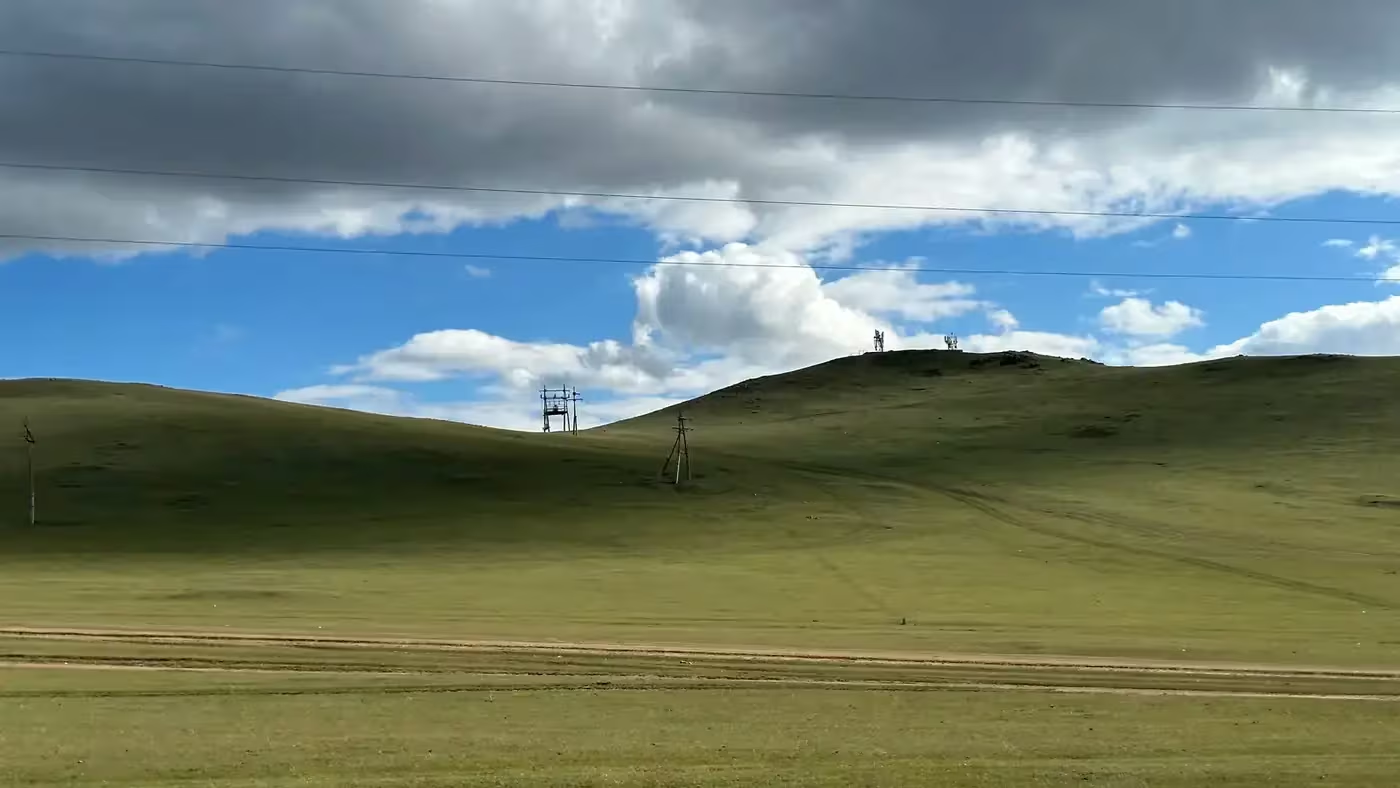
The Mongolian steppe is not empty, exactly — there are horses out there, and herds of sheep, and the occasional ger smoking a thin column of dung-smoke into a sky that goes on for a kind of distance I will not pretend to describe accurately. But it is unstructured by anything a Western eye is used to organising space. There are no fences. There are no fields. There are very few roads. The horizon is at the horizon, which sounds like a tautology until you have lived for a week in places where the horizon is the next building or the next hill. Here it is simply where the planet stops being curved enough to stay flat. You can see for what feels like a hundred kilometres in any direction. You can see the curvature.
The car — a Toyota Land Cruiser, the standard cross-country unit of measurement in this country — took us off the asphalt about two hours out and onto what was, generously, a track. We crossed a river. We crossed another river. We climbed a small pass with no markings on it. At one point my driver stopped, got out, walked twenty metres, looked at the ground, walked back, made a small adjustment to his heading, and continued. There was nothing visible at any point that I could see he was navigating by. The land was, as far as I could tell, a continuous beige plain in three dimensions. He drove for four hours and arrived, by an act of pure orientation I have no Western analogue for, at a ger no larger than the others, in a setting indistinguishable from any other setting we had passed, and stepped out as if we'd reached our usual booth at a usual restaurant.
The family came out to meet us. The grandmother first — in a deel, the traditional long Mongolian robe, in a colour I am going to call ember-blue, sashed with a long woven belt the colour of red ochre. Then the son. Then the daughter-in-law. Then the brother-in-law, who carried out a small wooden tray with a bowl of cheese curds, a bottle of vodka, and three small ceramic cups. The cups were filled. The first was offered to the eldest. The second to the driver. The third to me. We drank. The cheese curds — aaruul, dried for three months — could have been carved from the side of a chair. I tried to bite one and failed. The grandmother laughed without showing teeth. The son said, in the most patient English I have heard from anyone for whom it was their fourth language, that you have to suck on it for a while first.
The second evening there was a lunar eclipse. I had not planned to be in a country with no light pollution and a clear sky on the night of a total lunar eclipse, but Mongolia had planned it for me, and a small gathering had assembled: our hosts, two neighbouring families from gers a few kilometres east, a herder with a horsehair fiddle, and a man named Otgon who, I would later be told, was one of the better throat-singers in the soum. The sun set behind the western ridge. The bonfire was lit with dried sheep dung this time — sheep, I learned, burns a little smokier than horse, with a slightly different smell, slightly more wool, slightly less hay — and the whole steppe behind us turned a colour that is what blue does when there is no city in any direction and the air is exceptionally dry.
The moon came up red, and stayed red, and the eclipse worked its way across it the way an eclipse does, and as it did Otgon began to sing.
Throat singing, if you have not heard it in person, is the human voice doing two things at once. There is a low fundamental drone that sits at the base of the singer's chest like a cello held flat. And above that, simultaneously, there is a high whistled overtone, two octaves up, that the singer shapes with his tongue and lips into a wandering melody. It is one of the few sounds I have heard in my life that I had no prior reference for. It is not a chord. It is not a chant. It is, instead, the sound of one person being two instruments. Otgon sat at the edge of the firelight, drank a small cup of vodka, cleared his throat, and produced a sound that filled the steppe behind him in a way that nothing on this side of an opera house should fill anything. The fiddle player came in underneath. The moon, by then half-eaten, was the same colour as the embers in the bonfire. The grandmother sang along with the chorus — a song I later learned was about a horse, because all of them are about a horse — and her voice was the kind of voice that makes you understand, all at once, that there are entire musical traditions in the world that the West has simply not yet noticed.
I had nothing to add. I sat on a folded rug and watched the moon go dark.
By morning, the eclipse had been forgotten about by everyone except me, and the day's work had begun. I was put on a small Mongolian horse — the breed is a stocky, barrel-chested, exceptionally even-tempered animal of about thirteen hands — and ridden, slowly, out across the plain. Mongolian horsemanship has a different theory of operation than European horsemanship. The horse is not a partner. It is a particularly cooperative piece of furniture. You sit. You hold the rein. The horse does the rest. It also does not require you to be a good rider, which was a kindness extended to me on the first morning and acknowledged with relief.
We rode for two hours. The plain went on. The plain kept going on. None of my previous landscape-on-a-horse experience — the Highlands, Provence, a beach in Goa — had prepared me for the sense, after about ninety minutes of moving steadily across the steppe, that I had not arrived anywhere. There was nothing to arrive at. Every now and again a small herd of horses would crest a low ridge several kilometres away and disappear again. The herder beside me said nothing for the entire ride, and I understood by then that this was the conversation.
Later that afternoon we scrambled up a low band of granite outcrops a few kilometres from the ger. From the top there was a view I am going to attempt and fail to describe. The plain went on in three directions. In the fourth, it went on as well, only with a slightly different colour where the late light caught a band of distant grass. Nowhere was there a road. Nowhere was there a building. Nowhere, for hundreds of kilometres in any direction, was there a thing made by a person. There was just the country, doing what it had always done, with nobody on it.
"This is what most of Mongolia looks like," the herder said, conversationally, in a slow patient English that suggested he had explained this before. "Most of the country has no people in it. Most of the people who are in it are right here." He pointed at the ger, three kilometres off, a single white dot.
Mongolia has 3.5 million people across an area the size of Western Europe. Most of the world has no idea what it would look like to live somewhere where you could not see another person's house from anywhere outside your own. Most of Mongolia is exactly that.
Halfway through the trip we drove south. The drive south, in Mongolia, is a drive into a different country pretending to be the same one. The grass thins. The land lowers. The colour drains — from the saturated steppe-green of the centre to a paler, harder, gravelly brown — and then the sand begins. The Gobi is not the kind of desert a film shows you; it is not all sand. Most of it is gravel plain. The dunes, where they exist, are concentrated in pockets — the Khongoryn Els, the Bayanzag — and they are not contiguous in the way the Sahara is contiguous. The desert here is interrupted by everything: by mountains that come out of nowhere, by grassy plains that the rain reaches once or twice a year, by streams that crisscross the gravel and disappear into it.
I rode a camel for the first time in my life. The camel — a Bactrian, two-humped, calm to a degree I had not been led to expect by every Hollywood depiction of camels — was led by a man named Tsogbayar, who managed the small herd at the camp where we stayed. The riding posture on a Bactrian is different from a dromedary; you sit between the humps, which act as armrests and balance points, and the gait is a slow, swaying, hypnotic motion that I am told is not unpleasant after about four hours. After ninety minutes I was not yet at "not unpleasant," but I was getting there.
The stove in the Gobi camp, I noticed, was being lit with camel dung. The fuel changes with the terrain. On the central steppe it is horse and sheep. In the Gobi, where horses cannot graze the gravel and sheep are rare, it is camel. The principle is the same: you burn what walks across the land you are in. The smell is also slightly different — camel dung burns sweeter than horse, with a fragrance closer to dried grass than barnyard, and produces less smoke for the same heat. I made a note. The country, it turns out, has different perfumes depending on what your neighbours are.
The second afternoon we climbed one of the dunes. Tsogbayar led us up the spine of a low ridge — the dune was perhaps forty metres at its peak, a contour I had been led to expect would be a serious climb and which turned out to be a less serious slog through deep sand than the Sahara documentaries promise. At the top I turned around.
There is a view there I am going to try to describe and likely fail at. The peak of the dune sat in the middle of the most geographically improbable panorama I have ever stood inside. To the north, a sharp range of high mountains rose abruptly out of the plain — the Gobi Altai, snow still on the upper slopes in late spring. To the south, massive interconnected sand dunes ran for as far as I could see, the kind of dune system that gives the Gobi the small fraction of its surface that visitors imagine the whole thing to look like. Between the mountains and the dunes, a wide grassy plain ran east-west, and from this height I could pick out at least three small streams crisscrossing it, each one snaking through the green in a different pattern, like cracks in old porcelain.
Four landscapes in one vista. Mountain, dune, plain, stream. All of them meeting at a point I happened to be standing on. I am not in the habit of using the phrase geological diversity, but standing there I understood, for the first time, what people are reaching for when they use it. Mongolia is not one country in the way most countries are one country. It is at least four, all stacked on each other.
Back on the central steppe a few days later, sitting outside the family's ger watching the wind move grass, I got into a conversation with the herder's son. He had been doing most of the actual herding for two days while the grandparents conducted the social affairs of receiving a guest, and he turned out to speak better English than I had realised. At some point in the late afternoon we got onto the subject of what Mongolians were.
He said: "We are like you. We are Asians." Then he paused. "But not really."
He explained, in the patient diagonal way Mongolians have of explaining the obvious to outsiders, that there were the agile southerners — the Han, the Cantonese, the Vietnamese, what I came from — who were quick and slim and good at fine work, and there were the Mongolians, the Tuvans, the Buryats, the Kazakhs, the ones who lived between the south and the cold, who were built differently. Hard bones, he said. Wider through the chest. Easy to put weight on, hard to take it off. The body set up for the cold the way mine was set up for the warmth. We were cousins, distantly, sometime in the past, but we had been working on different problems for a very long time.
Looking at him — broad-cheeked, square-jawed, weighing about thirty pounds more than I did at roughly the same height — the diagnosis was difficult to refute. Looking at his children playing outside the ger in temperatures that had me wearing every layer in my bag, it was impossible to refute. Both of us, technically, were Asian. Neither of us, in any meaningful sense, were the same. He was telling me, with the matter-of-fact tone of someone describing two adjacent tools, that we were different tools.
On the fourth morning we drove an hour west to meet a falconer. Mongolian falconry is not the same as Kazakh falconry — that's the eagle tradition, further west still, in Bayan-Olgii — but central Mongolia has its own quieter version, smaller birds, less ceremony, and on a day so clear that the horizon was a single ruled line, we met a man named Davaa who had three saker falcons on a perch outside his ger, and one on his glove.
He let me hold one. The falcon went onto a thick leather glove that ran most of the length of my forearm. It weighed less than a paperback. Its eye was the colour of polished steel and looked, when it turned toward me, as though it was making a calculation about whether I was a thing it could fly. Davaa said something in Mongolian. The falcon adjusted. He said something else, and the bird's wings opened.
I ran with it. Not far — thirty metres, maybe forty — across the dry grass of the small plain in front of the ger. The wind caught the wings. The wings caught the wind. The bird, holding to the glove, held its wings flat and open and did not lift, only because Davaa had not asked it to. There is a feeling, when an animal that is built to do exactly one thing decides not to do that thing because you are present, that is not like anything else. It is part trust, part theatre, part the sense that the bird is humouring you and could, at any second, stop. I ran across the plain with a falcon on my arm and its wings open, and somewhere behind us Davaa whistled, and I do not think I have ever felt closer to the wind.
The bird went up at the end. Davaa called it back. It came back. It was a working day, and the falcon was, after all, an employee.
The thing about Mongolian cashmere — and you will not understand this until you have held a Mongolian-knit deel in your hands — is that it does not feel like cashmere as the rest of the world has decided cashmere should feel. The fibre is longer. The wool is softer because the goats live in colder weather than goats elsewhere and produce a finer undercoat. The yarn, spun by hand in a workshop south of UB I was taken to on my way back through, is thinner than commercial cashmere and significantly more durable. The result, knitted into a sweater or sewn into a deel, has a different drape, a different weight, a different warmth than its cousins. It also has different colours. Mongolian dye houses have access to plant dyes that European dye houses do not, and the result is a colour palette running through ember-red and sun-bleached blue and the particular greenish ochre of late steppe grass that I am not entirely sure any other country knows how to reproduce.
The grandmother of the ger had been wearing a deel in exactly that ochre. The daughter-in-law had been in a deeper blue, sashed with red. The young son's smaller deel had been a near-purple. None of them looked like costume. Everyone had been wearing a deel because it was the most practical garment for the climate. It is also — and you can take this from someone who has bought too many wool coats — one of the better-designed garments humanity has produced. Long enough to cover the knees on horseback. Wide enough to wrap twice around the torso for warmth. Sashed at the waist so the sleeves can fold up for work. Cut so the chest opens like a pocket when you sit down to drink tea. Anyone designing outerwear in a cold country should look very carefully at the deel before designing one more anorak.
The polyglot girl in the café had been wearing one too, I realised later, looking back. Mongolian designers have been quietly reworking the deel for street wear for about a decade, and the half-length, half-sashed version she had been in — I had taken it for a Scandinavian wool coat — was a contemporary cut of an eight-hundred-year-old garment. The young people are not wearing the deel because the older people are still wearing it. They are wearing it because, after a brief twentieth-century period of pretending they wouldn't, they have decided they will.
The best of the new cashmere is sold under a single brand name. Gobi Cashmere — the company is just called Gobi — is the largest cashmere producer in the world by volume and arguably the most quietly important fashion house in northern Asia. They run, in their UB factory, around two million garments a year. They have done campaigns with the Mongolian competitors from Physical: Asia, the Netflix strongman series; the imagery, of broad-shouldered athletes in cashmere knitwear against snow, was as good a piece of soft-power Mongolian branding as I have seen anywhere. Gobi's flagship in UB is two floors of a department-store building near the State Department Store, and when I visited it on my way back from the Gobi I noticed, with some delay, that the shop was full of Korean tourists — more Korean tourists, by my rough count, than every other foreign nationality in the building combined.
The Korean recognition gap is its own small puzzle. In Korea, Gobi is a known luxury brand, the cashmere coat one's mother-in-law might give one at a wedding. Korean tourists arriving in UB go to the Gobi flagship the way Japanese tourists arriving in Paris go to Louis Vuitton. Outside of Korea, the brand is almost unknown — a few European stockists, a few Beijing and Shanghai locations, no Manhattan flagship, no Selfridges concession, no Vogue feature. The largest cashmere producer in the world has, somehow, gone undetected by most of the world's luxury press. I bought a coat. It cost less than half what a similarly weighted Italian cashmere coat would have, and not one of the people who have asked me where I got it has heard of the brand. They will, eventually.
On the way back to UB we stopped at the statue. Everyone stops at the statue. The Chinggis Khan equestrian statue, fifty-four metres tall, two hundred and fifty tonnes of stainless steel, sits on a low hill about an hour east of UB and announces itself twenty minutes before you arrive. It is the largest equestrian statue in the world. The horse alone is the size of an apartment block. You can ride a lift up the horse and emerge between Chinggis's mane and the horse's head, three metres from the founder of the country's face. I rode the lift. I stepped out. He was looking past me, at something far to the east, with the patience of a man who had time.
I had been told he was tacky. He was not tacky. He was, instead, exactly the scale a country might choose if it had finally decided to put its founder on a hill after eighty years of being officially discouraged from talking about him under Soviet supervision.
I had a thought I had been delaying for several days. There is a widely cited genetics paper that estimates around eight percent of the men currently alive in the former Mongol Empire — from Korea to the Caucasus to the Caspian — carry a Y-chromosome traceable to a common male ancestor in the early thirteenth century. The paper, politely, does not name him. It does not have to. The dates line up. The geography lines up. The size of the descent lines up.
Looking around the viewing platform at the other visitors — all Mongolian, on a Tuesday afternoon — I did the maths in my head. There were maybe forty of us up there. In a plausible sample of forty Mongolian men, several are likely his direct paternal descendants. The man on the horse in front of us was, to a substantial portion of that small crowd, an actual great-great-great (continue for thirty more greats) grandfather. He was not a national hero in the abstract way Lincoln is a national hero. He was, statistically, in the room.
It was an interesting feeling. I looked at him. He looked east.
Mongolia is in the middle of switching its writing system. This is one of those slow constitutional changes that countries occasionally undertake the way individuals occasionally take up sobriety, with the same mix of conviction and quiet relapse.
The story, briefly: traditional Mongolian script — Mongol bichig — was developed in the early thirteenth century, around the time of Chinggis on the hill, and was the country's writing system for seven hundred years. It is vertical, beautiful, calligraphic in a way that mass-printed scripts struggle to be. It reads top to bottom, left to right; the letters connect into long flowing column-stems that lean slightly to one side. Mongolians wrote in it through the Yuan dynasty, through the dynasties after, through three centuries of Manchu rule, and into the early twentieth century. Then in the 1930s, under Soviet alignment, the country shifted to Cyrillic. Most everyone over fifty in Mongolia today reads Cyrillic comfortably and reads Mongol bichig only with effort, the way an English-speaker reads Old English. Most everyone under thirty reads neither one comfortably and reads English about as well as the other two.
And then, in 2020, the government announced that by 2025 official documents would need to be issued in both Cyrillic and traditional script. This means that signs are going up. Bilingual stationery is appearing. Schoolchildren are being taught a script their grandparents abandoned. The traditional alphabet is, for the first time in nearly a century, back in commercial use.
Walking around UB you can see this happen in real time. Older shops still operate in Cyrillic only. Newer ones add the vertical script down the side of the door, even where most of the customers cannot quite read it. Government ministries have updated their letterheads. Restaurants have updated their menus. Coffee shops add the script as a graphic element first, with the slow understanding that it will eventually become functional. The country is, very gradually, learning to read itself again. It is one of the more interesting cultural projects underway anywhere in the world right now, and is almost completely invisible to anyone outside the country.
Mongolia sits between Russia and China. It calls them, in the official foreign-policy language, the two neighbours. Everything else — the United States, Japan, South Korea, the EU, India — is what the Mongolians call the third neighbour: the strategic relationships maintained partly out of interest and partly out of the polite, sane recognition that a country of three and a half million people sandwiched between two empires of a billion-plus each is wise to have friends elsewhere.
I am not going to tell you what to think about the position. The position is complicated and the people who live in it are better placed than I am to think out loud about its arithmetic. What I will say is that Mongolia in 2026 has a parliament, a free-ish press, more opposition newspapers than several of its democratic neighbours, and a young population that listens to BTS and reads Murakami and is — quietly — very aware that it is not Russia and not China and that this matters to it. The country has spent fifteen of the past thirty years figuring out what it is, after a century of having that decided for it by larger countries, and it does not yet have the language for the answer, and it is in no hurry to be supplied with one by a passing traveller.
What I will also say is that nothing about the steppe will be the same in twenty years. The climate is moving. The herders are urbanising at a rate the country has not yet built infrastructure to absorb. The mining boom that I cannot describe in detail because everyone I asked about it changed the subject is reshaping the economy in ways that will be either very generous to the country or very expensive, depending on which decade you check in. The script is coming back. The cashmere is going up in price. The horse is, slowly and against the run of things, still the horse.
You should come now. Not because Mongolia is going away — it is not — but because Mongolia in this particular configuration, with the script just emerging, with the mining boom only partly cashed in, with the climate still leaving most of the steppe alone, with three and a half million people across a Western Europe of distance and almost none of them in the way, is something the country has been for the last decade and will not be for many more.
On my last morning at the ger, the grandmother gave me a small ceramic cup, the kind they had used for vodka on the first evening. She wrapped it in a piece of indigo wool. She did not say much. The son's wife, who had fed the stove twice a night without disturbing anyone, walked me to the door of the ger. The horse-dung stove was already on for breakfast. The smell, which had once been the smell of dung, was now — correctly and irreversibly — the smell of warmth.
The drive back to UB took six hours. We saw four other vehicles on the road. We saw twelve thousand sheep. We saw, twice, a herder on horseback come over a ridge in the distance and disappear again. We saw, once, an eagle so large it looked from a distance like a small drone. We did not see another foreigner for the entire drive.
I sat in the airport that evening waiting for the flight home. The departure board was bilingual: Cyrillic on the left, traditional Mongolian script down the right side of each entry, with English underneath. The font of the traditional script, even at airport size, was beautiful. I watched it for a while — the way you might watch a writing system being remembered. The flight boarded. The plane took off. The country fell away under the wing.
If you go: stay in a real ger, not the tourist-camp version. Drink the salted milk-tea. Try the aaruul; suck on it; don't try to bite it. Watch the moon come up in a place with no light pollution — not just on an eclipse night, any night. Ride a horse on the steppe even if you are not a horseperson; the small Mongolian horses will cover the lack. Drive south at least once; the country switches into a different country halfway through the drive, and the four-landscape view from a Gobi dune is in nobody's slideshow yet. Hold a falcon if anyone offers you one. Buy a deel. Walk through the Gobi flagship even if you don't buy a coat. Stop at the statue. Look him in the face. Do the maths.
And come now. The script is coming back; the airport's departure board now reads in two alphabets. The grandmother in the ger knew where everyone's feet were even with the door closed and the light off. The herder's son, across the bonfire, said: we are like you. But not really. Both halves of the sentence were correct. The eclipse moved across the moon. The throat-singer hit a note that filled the steppe. The dung kept burning, and somewhere outside the ring of firelight, the country kept being itself.