I met Sonam at the airport, and the first thing I noticed about him was his shoes. Black leather, polished, the kind you might wear to a wedding. He wore them for the entire four days we drove together. Up monastery hills, around dzong courtyards, on the descents through cardamom forest. They never came off. I asked him about them once, gently. He said: when I am with guests, I dress for the guests. It was not a complaint. It was a statement of principle.
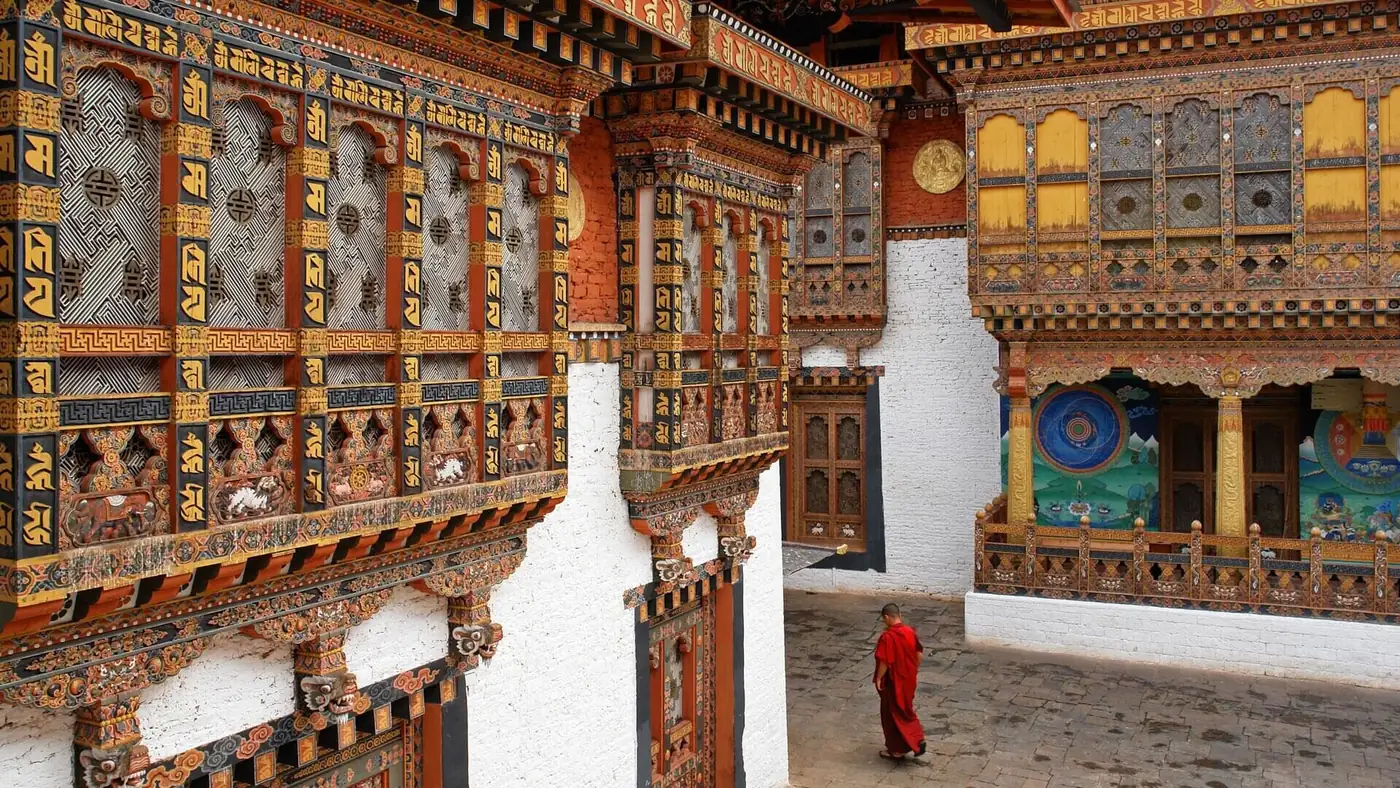
Bhutanese formal dress is part of the Driglam Namzha, the official code of conduct that governs how citizens present themselves in public. Men wear the gho, a knee-length robe wrapped at the waist. Women wear the kira, a full-length wraparound dress. Both are required attire in dzongs, schools, and government offices. Sonam wore his gho for half the trip and a smart shirt-and-trousers combination for the other half, and the polished shoes always.
Where I'm from, dressing well is mostly performance. In Bhutan it read as respect — for the work, for the guest, for the institutions you walked into. The whole code is a quiet way of saying: this place takes itself seriously.
We drove the four hours from Paro to Thimphu, then on to Punakha, then up into Phobjikha. The roads are mostly two lanes, mostly clinging to the side of mountains, mostly without barriers. Sonam drove them at the pace they require, which is slow. Bhutan has the slowest pace of life of any country I've been to, and the roads are partly the reason. You cannot rush Bhutan. The geography rejects rushing.
Sonam was from a village in the east, near the border with Arunachal Pradesh — the Indian state that China still claims. Getting home took him over two days by road. He didn't seem bothered. He had a wife and two children he saw twice a year, and otherwise he drove the western circuit, which paid better than anything in his home district. When I asked if the distance was hard, he said: the roads are getting better. They added asphalt to the bridge near his house in 2024. He said this the way someone else might describe a recent gift.
He was, with me, the easiest company I've spent four days in a car with. Himalayan warmth is a quieter thing than you expect — understated, genuine, never performed; the kind that simply stays available to you, always there to help without ever making a point of it. Sonam personified it. Quiet, patient, capable of long silences without strain.
It was on day three, somewhere on the descent from the Dochula pass, that he asked the question.
"Is Chinese food and Japanese food the same?"
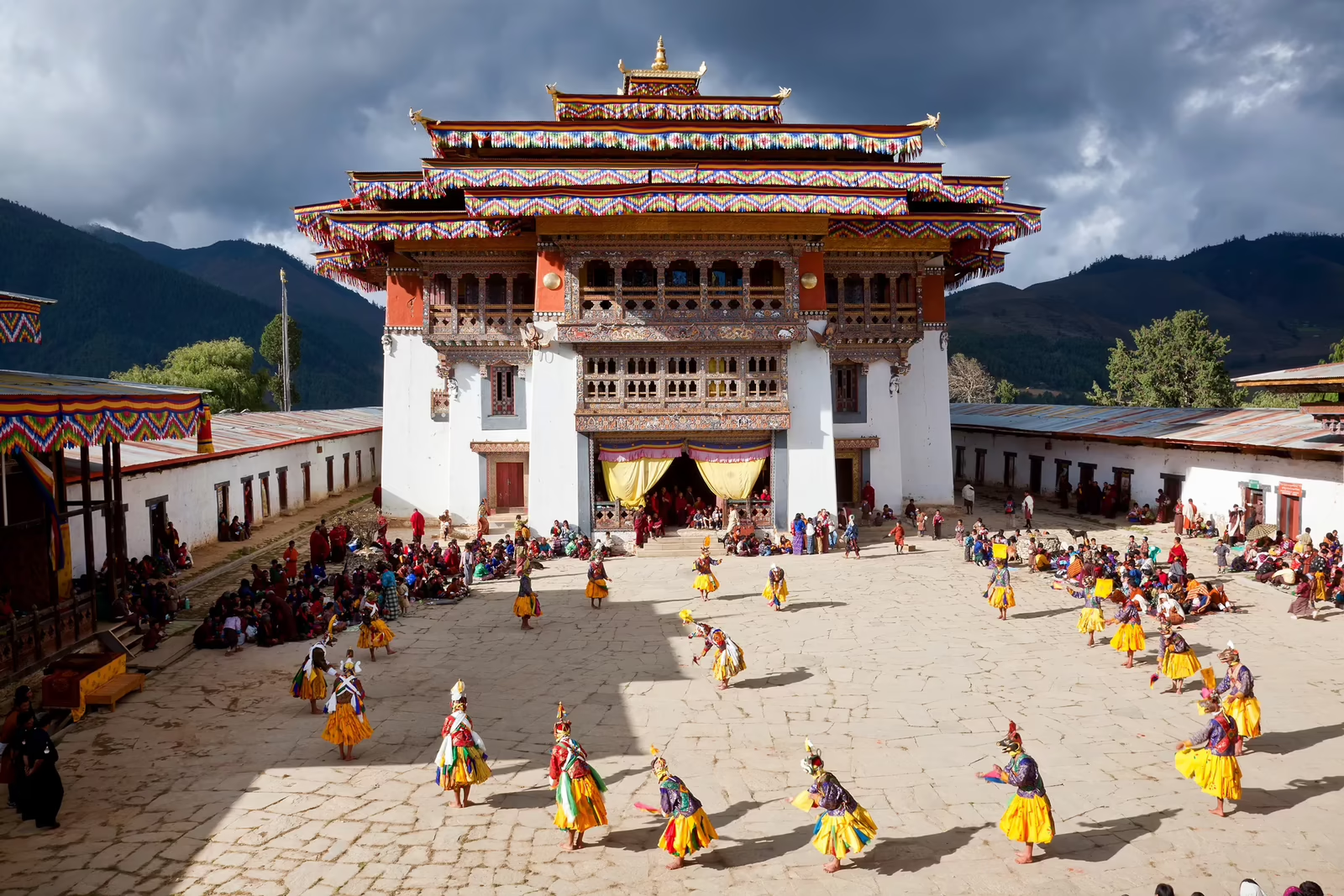
There's a way to tell this story where Sonam is reduced to a punchline. That's not what happened. Sonam had grown up bordered by China to the north and India to the south, and culturally Bhutan is overwhelmingly oriented south. The Bhutanese alphabet derives from Tibetan but daily food, the closest cultural cousins, the dominant trade and television all come from India — Assam, West Bengal, Sikkim. China is, for most Bhutanese, an abstraction. A snowy presence on the other side of mountains too high to cross. From his vantage, Chinese and Japanese food were two distant cuisines from a part of the world that wasn't his — about as much sense as lumping together Italian and Greek food makes from Tokyo.
I told him: it's as different as Indian food and Bhutanese food.
He stopped the car. "Really?"
I described some of the differences. Soy sauce. Soba. Sashimi. Wok versus grill. He listened with attention. Then he said: I never knew. I thought it was all just the same kind of food.
We drove for another twenty minutes in silence, both of us thinking, I imagine, about the same thing — that everyone, everywhere, navigates the world from inside a cultural map of their own making, and the map is always partial. The question is whether you know your map is partial. I am still not sure mine is.
The Bhutanese government is a constitutional monarchy. There's a king — currently Jigme Khesar Namgyel Wangchuck, the fifth in the line — and an elected parliament that the king's father, voluntarily, helped bring into being in 2008. Voluntarily handed away absolute power. The country had no obvious push toward democracy, and yet he insisted on it. He stepped down, the new king took the throne, and Bhutan held its first competitive elections.
Every Bhutanese person I spoke to said, unprompted, that they love their king. They said it as a fact, not as an opinion that could be otherwise. I'm wary of this kind of unanimity in any country, but every account I have read of contemporary Bhutan reports the same finding. Sonam, who had no reason to perform, said simply: he is a good man. He loves the country. We are lucky.
I asked Sonam, on day three or four, what happens if Bhutanese people don't like a government policy.
He thought for a moment. "We ask," he said. "And usually they change it."
I asked if he was joking. He wasn't. He gave me an example — something to do with a school district, several years back — where a community had requested a change, the change had been made, and that was that. He said it the way you might describe a household appliance working as expected.
That's not how policy feels where I'm from. To hear it stated as the operating principle by a man driving a Toyota over a mountain pass at thirty kilometres an hour was, to be honest, disorienting.
I don't want to oversell this. There are always things missing in any country's account of itself. Voices that don't make it through. But I'll report what I observed: in a country where Buddhism's central teaching is that suffering comes from attachment, the relationship between governed and governing seemed, at least in the western valleys I traversed, calmer than I had any frame for.
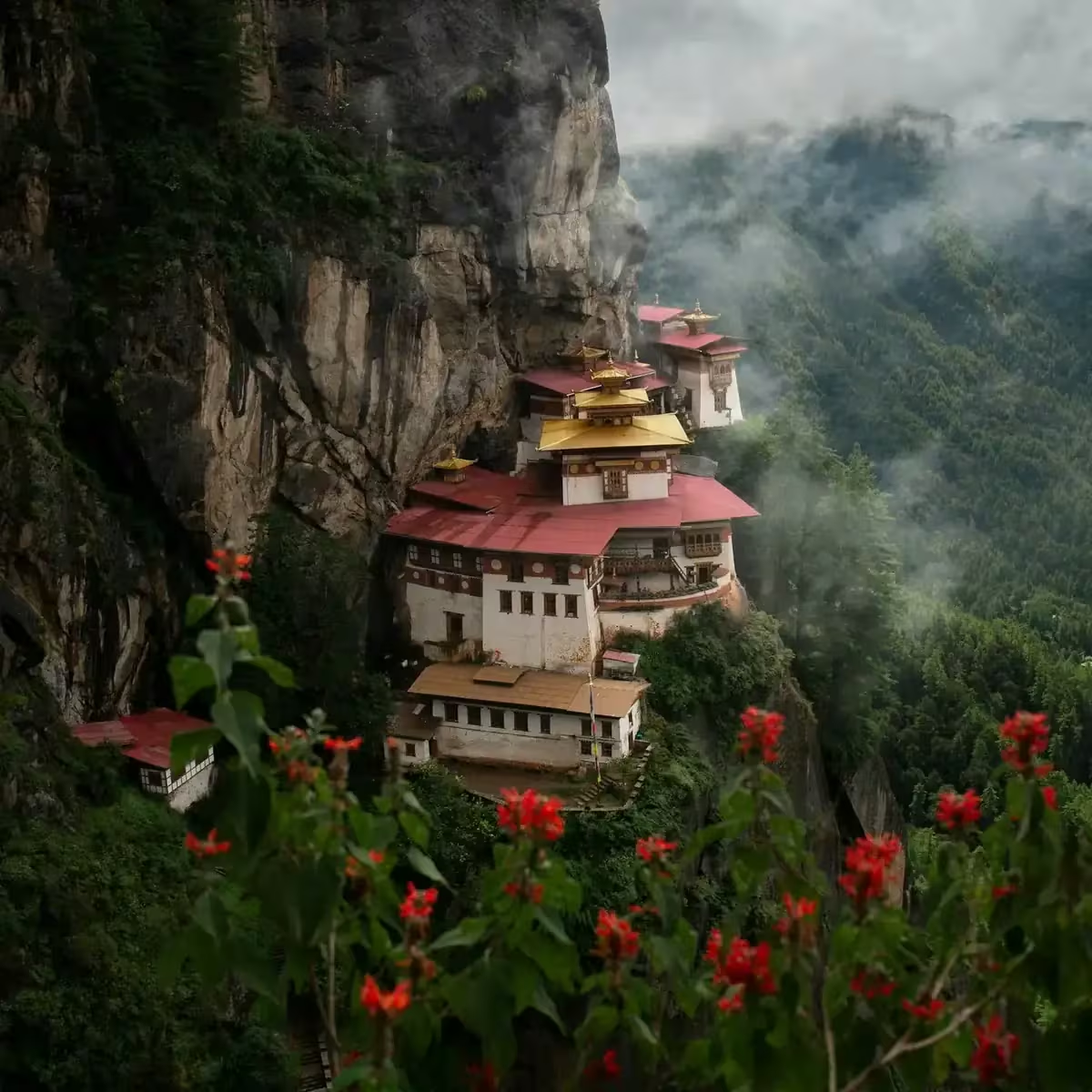
We hiked Tiger's Nest on the fifth day. Taktsang Palphug Monastery, clinging to a cliff face nine hundred metres above the Paro valley. The legend is that Padmasambhava — the eighth-century master who brought Buddhism to Bhutan — flew here on the back of a tigress, meditated in a cave for three years, three months, three days, and three hours, and the monastery was built where he landed.
The hike is three to four hours up. Switchbacks, exposed sections, prayer flags strung between trees that have been there for decades. We weren't the only ones climbing. A Bhutanese family was ahead of us — three generations, the youngest a baby wrapped in a striped cloth and tied to her mother's back. The mother walked at a steady pace, talking with her sister. The grandmother walked behind. The grandmother was, conservatively, seventy. She was not slowing.
The baby was facing backward, looking at me. We made eye contact for two switchbacks before I broke first.
This was a pilgrimage for them. They'd come from somewhere east, taken two days on roads, climbed the mountain. They would do this — the journey and the climb and the descent — and go home. That was the trip. Tiger's Nest was the destination not in the way I had treated it, as one of three things to see in a week, but in the way the original meaning of the word "destination" intends: the thing you go to.
At the top, the monastery is small and sparse and beautifully kept. Monks chant. The air at three thousand metres is thinner than you expect. We sat in one of the chambers for a while. Nobody said anything. Outside, far below, the valley was its full Bhutanese width — a green bowl held by mountains.
Three other things, briefly.
The food. The national dish of Bhutan is ema datshi, which translates as "chillies and cheese." Whole green chillies, sometimes red, in a thick yak-cheese sauce. Served with red rice. By any reasonable global culinary standard, bizarre. After three rounds, very good. Bhutanese cuisine is the only one I've encountered that uses chillies as a vegetable rather than a spice — once you accept this, the rest of the menu is coherent. Sonam set up our lunches at altitude — wool blanket, tin containers of ema datshi and rice, a thermos of butter tea, the view of peaks above cloud thirty kilometres in either direction. There is no rush. The food has time. So do you.
The prayer wheels. Cylinders inscribed with mantras, mounted in temples, by roadsides, at thresholds. You spin them as you pass. Each spin is, in the Buddhist account, equivalent to reciting the mantra inside. The cumulative effect — every doorway, every courtyard, every stream harnessed to spin a wheel mechanically through the night — is that you're constantly producing prayer. The country is a kind of prayer-generating machine.
And one evening, the dotsho — the hot stone bath. A wooden tub built into a small outhouse beside the lodge. They filled it from a stream, packed it with local herbs (artemisia, juniper, mountain mugwort), and on the partitioned side of the tub, a man with tongs lowered a giant heated boulder taken straight from a fire. The water hissed and steamed. The herbs released. I sat in this for forty minutes. There was no app, no temperature dial, no spa playlist. The man came back periodically to add another stone when the temperature dropped. I've had every kind of polished spa experience. The dotsho was better than all of them, cost effectively nothing, and the difference was that the people running it had been running it the same way for hundreds of years and saw no reason to change. Bhutan figures out what works. It then keeps doing it.
I grew up in Hong Kong. The kids I went to school with wanted to be lawyers, doctors, founders, bankers. The career questions started in primary school. By thirteen, you were already being asked which Ivy League you would aim for.
In Bhutan, when I asked Sonam what kids in his village wanted to be when they grew up, he said: monks. Some want to drive trucks. But mostly monks.
I'm not making the case that one is better. I'm making the case that I hadn't, before going, fully appreciated that there are places where the most aspirational career is to step out of the economic system entirely, take vows, and live at a monastery — and that this is held in the same regard as becoming a doctor in the West. The Bhutanese kids growing up wanting to be monks aren't opting out. They're opting in to the life their society values most.
That's what Gross National Happiness actually means. Not the metric. The fact of having decided what to value.
If you go: bring soft shoes — your guide's will be polished. Listen more than you speak. Let your guide teach you. The country will teach you also, but slowly.