The rat was small and businesslike. It had come through a fold in the canvas where two seams met, found my dry-bag in the dark, decided the leather strap was worth investigating, and bitten through it. Now it was halfway across the floor of the tent with what it considered, presumably, its prize.
I lay there in the half-light at four-thirty in the morning, watching it work, and thought: it costs more to spend one night in this tent than half of Tanzania earns in a month. But the rat doesn't know that. The rat is just hungry.
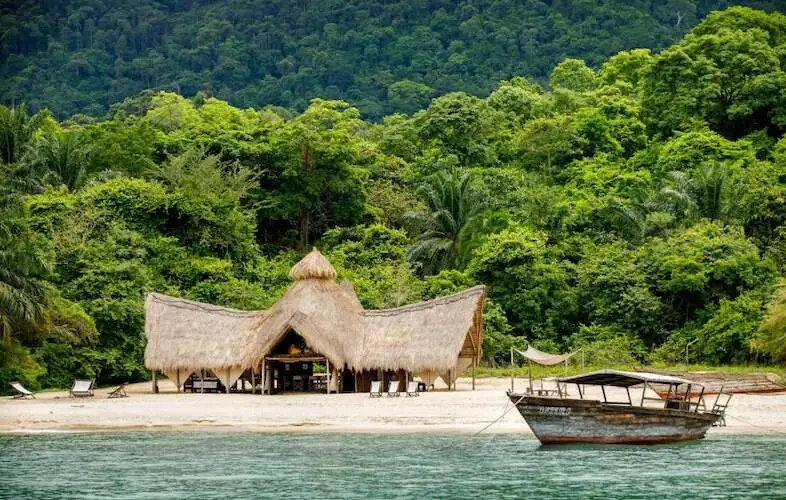
The Mahale Mountains National Park sits on the eastern shore of Lake Tanganyika — the second-deepest freshwater lake on earth, and the longest, narrow as a country. From the air, if you happen to fly over it, the lake reads as a blue scar between the highlands of western Tanzania and the country of Burundi. From the ground, you arrive by boat. Six to eight hours from Kigoma, sometimes longer if the wind comes from the south, which it does without warning. There is no other way.
We came in late afternoon. The boat was a wooden one, painted blue, captained by a man named Saidi who has done this run twice a week for nineteen years. The lake was glass for the first hour and then suddenly not, and Saidi shrugged and said the wind comes when it comes, and we sat low in the boat and stopped trying to talk over the engine.
Greystoke Mahale is at the end of the journey. Eight tents under thatch, set back from the beach where the forest meets the water. Beyond it: the mountains. Above the mountains: chimpanzees that have never learned to fear people, because no one has ever given them reason to.
The first thing the forest taught me, and it took until day three to notice, was that everything here is calibrated for the conservation of energy. The chimps don't run; they swing through the canopy with the precision of someone who has run the cost-benefit analysis on every movement. The colobus monkeys — black and white, with tails twice the length of their bodies — sit motionless for thirty-minute stretches, watching. Bushpig moves at dusk only, in a single line, single direction, no wasted footstep. Even the leaves seem to drop with deliberation.
I'd come from a city where everyone walks faster than they need to. Where you can identify a stranger as a tourist by the way they move — too eager, too efficient, too convinced that hurry produces something. The forest had no patience for this. It absorbed my hurry and gave back nothing. After a few days I started moving at the forest's pace, which is to say almost not at all.
I started noticing other rules. The forest doesn't waste, but it also doesn't share. There are seasons of generosity and seasons of withholding, and the animals here have learned which is which, and they do not trespass. The fig tree fruits in February. The chimps know. They wait. They do not eat unripe fruit because unripe fruit costs more in digestion than it returns in calories. The forest is a long-running calculation about what's worth doing and what isn't. The animals here are excellent at this calculation. They have to be.
The troop in this part of the forest is led, currently, by a male called Pim. He inherited from a male called Kelele, who lived to be in his forties, which is unusual. Most chimps in Mahale die in their thirties — the males in particular, because the politics is brutal. The hierarchy in a chimpanzee troop is not the romanticised "one big happy family" version most documentaries reach for. It's specific, contested, and frequently violent. There are alliances, betrayals, factional disputes. Males groom males they need to keep close. Females groom males who can protect them. The whole structure is held together by physical intimacy that is not, exactly, intimacy.
We watched Pim for two hours one morning. He was eating fruit on a slope above the stream. Three other males were within fifteen metres, doing the same thing, in three different trees. Nobody acknowledged anybody. They ate; they watched each other not watching; the only sound was the soft thud of seeds falling.
What I had not expected to find were the solitaries.
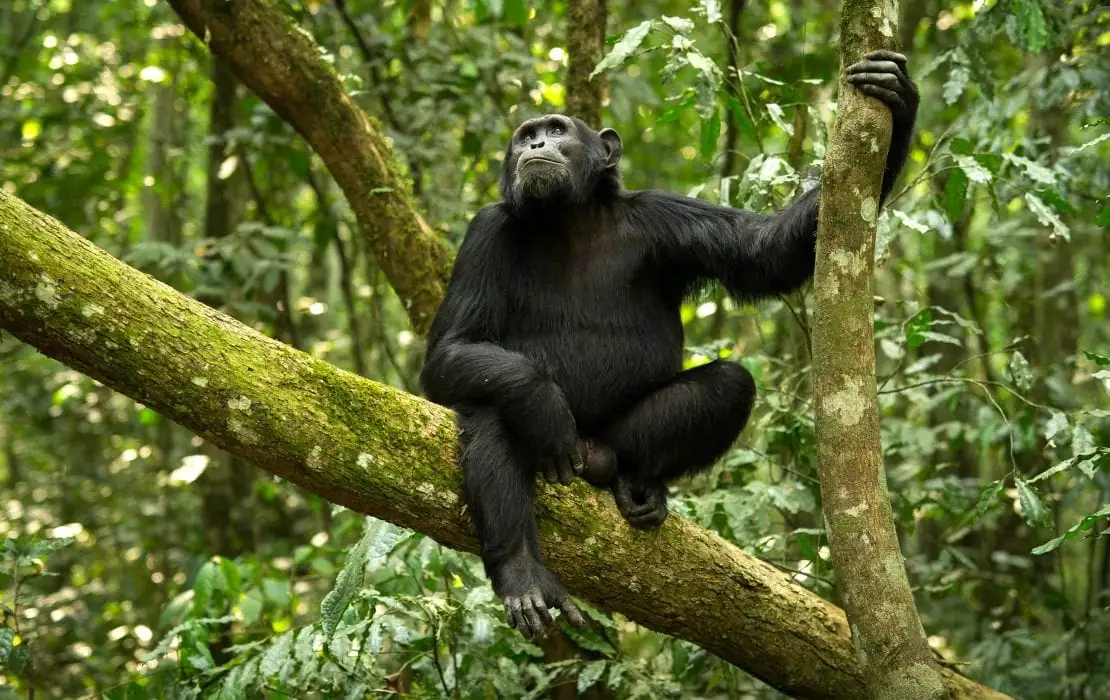
There is, in this forest, an old male called Christmas. He is somewhere in his late thirties — old for a chimp — and at some point he simply stopped participating in the politics. He sits on a particular ridge for hours. He moves alone through the territory. The other chimps know he's there; they leave him be. Nobody seems to know exactly why he withdrew, and the guides don't speculate, but he's been doing it long enough that they treat his solitude like weather: a fact about Christmas, not a state to be remedied.
I thought about Christmas a lot, that week. The implications — that you can live in a society that is fundamentally about politics and choose, mid-life, to step out of it without leaving — felt relevant in a way I'm still working through.
The camp staff are mostly Tanzanian. Ali, the head guide, is from a village two hours up the lake. He's been working in Mahale for seventeen years. Joseph cooks. Saidi runs the boat. There's also Hassan, who handles the radio, and Mariam, who manages the tents. They were, without exception, warm and open company — the kind of unforced East African hospitality that makes a guest feel less like a visitor than someone who simply happened to belong there.
I want to be careful here. There's a particular kind of travel writing that arrives at a place like Mahale and writes about how warm the locals are, how welcoming, how their smiles and songs and sense of community contrast with the writer's cold modernity. It is, almost always, a sentence written from inside the privilege of being able to leave. Ali was warm because Ali is warm. Also because he is being paid to host me, and his livelihood depends on guests writing the kind of review that brings more guests. Both things are true. The warmth was real and so was the structure beneath it.
What surprised me was when the structure dropped.
On the second-to-last evening, after dinner, after the lake had gone black and the only light was from kerosene lanterns and the faint glow of a distant fishing boat, they started singing. There was no obvious cue — Joseph just began humming something, and Ali joined, and Hassan was clapping, and within five minutes the entire camp was up. It wasn't performative. It wasn't for the guests. It was for them, and we happened to be there.
The song went on for maybe forty minutes. Some of it was Swahili, some Hehe, some I couldn't place. There were jokes between verses that everyone except us understood, and they laughed at them, and it didn't matter that we couldn't follow. Mariam danced. Hassan harmonised. Ali — who had spent the whole week being the careful, courteous, professional head guide — was bent double laughing at something Joseph said.
Eventually Joseph noticed us at the edge and waved us over. Within ten minutes I was clapping, badly. Within twenty I was being taught a step that I did not learn correctly. Within thirty I was being laughed at by Hassan, who I will note was being laughed at by Mariam for laughing at me, and the whole thing collapsed into a circle that was no longer about the song and had become about the joke that was the song.
This is the thing nobody tells you about travel: the most memorable moments are almost never the ones you booked. They're the ones you happened to be in the room for.
Which brings us back to the rat.
After the singing, after they'd gone back to the staff quarters and we'd gone to our tents, I lay there listening to the night — which in Mahale is not silent, exactly, but is silent of human sounds. There's water on the shore. There's wind in the canopy. There's something distant, on the other side of the ridge, that might be a bushbaby. And then, very close, the small busy sound of teeth on leather.
Greystoke Mahale is one of the most expensive camps in East Africa. The tents are exquisite. The linens are white. The food is excellent. The rat does not know any of this. The rat lives in the forest, where everything is calibrated for the conservation of energy, and the rat has determined that my dry-bag strap is a worthwhile use of two minutes of jaw work.
I let it finish. It seemed wrong to interrupt.
In the morning I checked the damage — a clean cut, two centimetres long, through good leather. I admired it for a moment. Whoever had owned that leather before had paid a lot for it. The rat had taken what it needed and gone. The forest's calculation: efficient.
What I left Mahale with was not, in the end, the chimps — though they were extraordinary — but a rearranged sense of how to spend energy.
The forest knows what's worth doing. The chimps know who's worth grooming. Christmas knows when to step out. Ali knows when to sing. Mariam knows when to dance. The rat knows that leather is worth two minutes of work and an exit through the canvas before dawn.
I came home and looked at my own days — my own city, my own hurry — and noticed for the first time how much of what I do produces nothing. The forest would have edited me. The chimps would have grown bored. Christmas, on his ridge, would have looked over once and gone back to whatever he was doing.
If you go: take the boat slowly. The wind will come when it comes. Trust Ali. The chimps will arrive when they arrive, or they won't, and either way is fine. Bring a hard-shell case for anything leather. The rat is not malicious. The rat is hungry.
The lake will still be there. It has been there for nine and a half million years, which is a number that becomes meaningless before you can get your head around it. It is, possibly, the oldest large body of fresh water on earth. People have been singing on its shores for as long as people have been people.
You will be there for a week.
It is enough.