The hike down a volcano on a hurt knee is a slower business than the hike up. I was sitting on a slab of rock about two-thirds of the way back to the parking lot, somewhere in the porous middle of Mount Ijen’s eastern flank, when a man wheeled past with what he insisted was a Lamborghini.
It was not a Lamborghini. It was a wheelbarrow. Specifically, it was a wooden cart with two metal handles and a cushioned plank, on which sat an Australian woman who had, at some earlier point in the night, made a decision she now appeared to be reconsidering. The man behind the cart was leaning his whole body into the descent. The cart had been painted, at some optimistic earlier moment, in racing stripes. On the side, in careful black paint: LAMBORGHINI.
“Ijen Lamborghini,” he said to me, smiling, as he passed. “Faster than walking.”
I had been told about this by my driver the previous afternoon. Halfway up the trail, if you blow out a knee or simply make a poor life decision, there are men who will take you the rest of the way for a fee. The men with the carts are not the miners. They are a separate trade running on the same mountain. The miners are the people you have been climbing past since two in the morning, in twos and threes, shouldering wicker baskets of yellow rock that weigh as much as the men carrying them; they break sulfur loose from the inside of the crater for somewhere between two and four dollars per load and they take it down the long way, on foot, on a bamboo pole across their shoulders. The men with the painted carts have grown up alongside the miners’ trade like a second, parallel guild — the porters — whose entire business is pushing tourists back down the same trail at sunrise. Same mountain, same hours, different shoulders.
The man I had just watched go past had probably done four or five cart-runs already that morning. The Australian woman in the wheelbarrow, riding sidesaddle down a goat track in the dark while a man in his fifties leaned his entire ribcage into the cart’s handles, looked like she was beginning to understand this.
I sat for another minute. I had paid one of the miners, earlier in the day, ten dollars for a small sulfur sculpture he had carved at the top of the mountain on his break. It was the size of my fist and shaped like a sea turtle. He had pulled it from inside his shirt with the slightly embarrassed expression of someone presenting you with a craft project. I had carried it down the mountain with me. It now sat at the bottom of my pack, smelling like a struck match.
I stood up. The Australian woman went past me again, going the other way this time, in the opposite Lamborghini.
This is, in the end, what East Java does to you. It runs an economy of small unbearable things alongside an economy of cathedral-grade beauty, and it lets you decide which you are paying for.
The week began in Yogyakarta, which is a city most people outside Indonesia do not know exists, and which is rapidly becoming the place that everyone inside Indonesia would like to move to. The first thing you notice is the absence of Jakarta. Yogya is the same country but not the same century. The streets are slow. The traffic moves. There are sidewalks. You can sit at an outdoor café in the late afternoon without the air tasting of diesel and someone’s regret. People look at you, not because you are a foreigner — there are plenty of foreigners — but because they want to know where you are from, and once you tell them, they want to know if you would like to play chess.
I was invited to play chess on four separate evenings by four separate retired men, none of whom spoke English beyond the names of the pieces. I lost every game. The men were unfailingly polite about it. One of them, a former civil engineer who had moved down from Jakarta with his wife the previous year, paused for a long time over the board on our second game and then, without looking up, said: here, the air is good. He said it the way you would describe a thing you had been promised your whole life and had only recently received.
The reason Yogya is filling up is that Jakarta is breaking. The capital is sinking, literally and structurally — the north of the city is now below sea level, the government has officially designated a new capital up in Borneo, and the people with the means to leave have started to leave. Their preferred destination, by some growing margin, is Yogyakarta. It is the cultural capital. It has the Sultan. It has the universities. It is built on solid ground. You meet former Jakarta residents at every batik shop you walk into. I counted thirty batik shops in one evening before I gave up. The number is higher.
But the real reason to come to Yogya is not the city. It is the two enormous monuments squatting on opposite sides of it, separated by about forty kilometres of farmland, and built — give or take a century — at roughly the same time. One is Borobudur, the largest Buddhist monument on earth. The other is Prambanan, the largest Hindu monument in Indonesia. They are both spectacular. They are both well over a thousand years old. They are both standing, more or less intact, in the world’s most populous Muslim-majority country.
This is the thing I want to dwell on for a moment. Indonesia has 280 million people, more than 85 percent of whom are Muslim. There is genuine devotion. The call to prayer comes through the speakers in every town. The women in the food stalls wear hijabs, the men go to mosque on Friday afternoons, the country observes Ramadan with a seriousness that is hard to overstate. And yet you can walk to the top of Borobudur on a Tuesday morning and find Indonesian schoolchildren on a field trip, in their uniforms, posing for photos with stone Buddhas while their teachers explain — in Bahasa, with no apparent dissonance — what the Buddhist concept of the Eightfold Path actually means.
I asked a guide at Prambanan how it was that the country preserved its Hindu and Buddhist past so carefully. She thought about it for a moment. “Because it is ours,” she said. “It is older than the religion. It is the country.”
This is the sort of answer that only lands in a country that has had a thousand years to think about the question. In some places, the past is the thing the present is competing with. In Yogya, the past is the thing the present is standing on top of.
The monuments themselves remind me, in a way I have to be careful with, of other places I have spent time. Borobudur, with its concentric stupas climbing toward a single bell at the top, is the obvious sibling of the stupa fields outside Bagan and the great stupa at Boudhanath; the same architectural grammar reapplied in Java, several centuries earlier than its cousins. Prambanan is the Hindu equivalent of Angkor Wat or Banteay Srei in Cambodia, or Ayutthaya in Thailand — a temple compound where the carving on the lintels tells the Ramayana, scene by scene, around the base of the central shrine. Most of the schoolchildren can recite the story. None of them practice the religion the story comes from. The story is older than the religion they were raised in. The country has, very deliberately, kept the story.
Before I came, several friends had asked the question I had been asking myself. Is Indonesian food not just kind of… bland? I had spent three years in the Philippines, where the food was the one thing about the country I never quite warmed to. I assumed Indonesia, sharing roughly the same equator and the same coconut, would be similar.
Indonesia was not similar.
The first thing I had was gado gado — boiled vegetables, tofu, hard-boiled egg, a peanut sauce that had been thinking about itself for some hours — served with a small disc of lontong, which is rice that has been compressed into a cylinder and steamed until it has the texture of an extremely polite cake. It was the best peanut sauce I have ever eaten. The peanut sauce in Bangkok is more famous. It is not better. The peanut sauce at Yogya’s gado gado stand was made by a woman who would have been within her rights to charge five times what she did, and I tipped her accordingly. She refused. We had a brief polite argument about it which I lost, again.
Other things I ate: soto ayam (chicken broth, turmeric, glass noodles, the entire concept of fortification distilled into a clear yellow soup); proper rendang, slow-cooked for hours until the beef collapsed into a paste with the consistency of memory; nasi goreng and mie goreng in their unglamorous, weekday, side-of-the-highway versions, which are better than every Instagrammable version I have eaten anywhere else. Even the coffee buns — sweet bread filled with butter, served with thick black Sumatran coffee — were better than they had any right to be.
I am not going to claim Indonesian food is the best I have eaten in any country. Mexican, Japanese, Moroccan and Chinese still hold their positions on that personal podium. But Indonesia walked onto the field a contender and finished, comfortably, in the middle of the pack.
You leave Yogyakarta heading roughly east, on a road that takes a full day to traverse, and the country slowly de-saturates into what people imagine when they imagine rural Indonesia and forget about Bali. The towns are small. The traffic thins. Rice fields appear and disappear in long green slabs. You pass mosques with painted minarets, farmers’ markets selling chilies stacked in cone-shaped pyramids, and once — in a town whose name I have lost — a man on a moped balancing what was unmistakably a stack of unbaked clay roof tiles taller than his bike. I watched him for as long as he was in the same direction we were going, which was a surprisingly long time, and the stack of tiles never moved.
There are not many tourists on this road. The buses that bring foreigners between Java’s checkpoints — Yogyakarta, Bromo, Ijen, Bali — bypass the in-between bits, and most travellers do the entire stretch in a single overnight push that compresses several hundred kilometres of rural Java into a darkened minibus window. I would, on balance, recommend against this. The in-between is the whole point of going. The view of a valley from a mountain pass with no name, taken at four in the afternoon as the sun starts to thicken and the haze comes up off the rice fields, is the part of Indonesia that tourism has not yet found a way to package, and you should look at it while it is still unframed.
A few hours short of Bromo, my driver stopped and asked if I wanted to see a waterfall. I said yes. He said it would take an hour, possibly less. He said this with the slightly tired smile of a man who had had this exact conversation many times.
Madakaripura is a waterfall most foreign visitors have not heard of, which, in my limited experience of the country, is the highest possible recommendation. You park in a small dirt lot. You walk twenty minutes along a narrow gorge, through a creekbed surrounded by walls that get steadily taller and greener as you go in, until the gorge widens slightly into a circular bowl with a roof of falling water about a hundred metres tall.
It is not a waterfall in the way you imagine waterfalls. It is a curtain. A perfect circular curtain of falling water, fed by a creek that splits at the top of the cliff and lands all the way around the bowl, behind a small Hindu shrine, into a pool the colour of cold steel. You stand at the bottom and you cannot see anything that is not water. The walls behind the curtain are green with moss in the way that wet stone in tropical countries gets green — the green of something that has not been dry in centuries. The light comes through the curtain in slow vertical sheets. The whole place is cold, in the way water that has fallen a hundred metres is cold, and the cold is what you remember.
It was, in the most direct sense, the most beautiful thing I saw on the entire trip. I have stood at Iguazú. I have stood at Victoria. Those are louder. They are wider. They are more famous. They are not, somehow, more beautiful.
The walk back took twenty minutes. The guides — there are guides at Madakaripura, technically, in the sense that there is a man walking faster than you in front of you, glancing over his shoulder periodically to make sure you have not fallen into the creek — looked, by the time we were back at the car, slightly tired. It was eleven in the morning. They had done this walk already this morning. They would do it again that afternoon. I had paid them somewhere in the neighbourhood of three dollars per person, which is the going rate. They had walked me to and from a place that, for me, was an experience I will remember for the rest of my life. For them, it was Tuesday.
I think about this still. Not in a guilty way. Just in the way you think about people whose entire life is the place that, for you, is the photograph.
There are two ways to sleep near Mount Bromo. The lodge in front, on the lip of the caldera, where every window faces the lava sand. The cabin compound behind it, set back a kilometre into the dark, where the windows face the stars.
I stayed in both, on two nights, for entirely separate reasons.
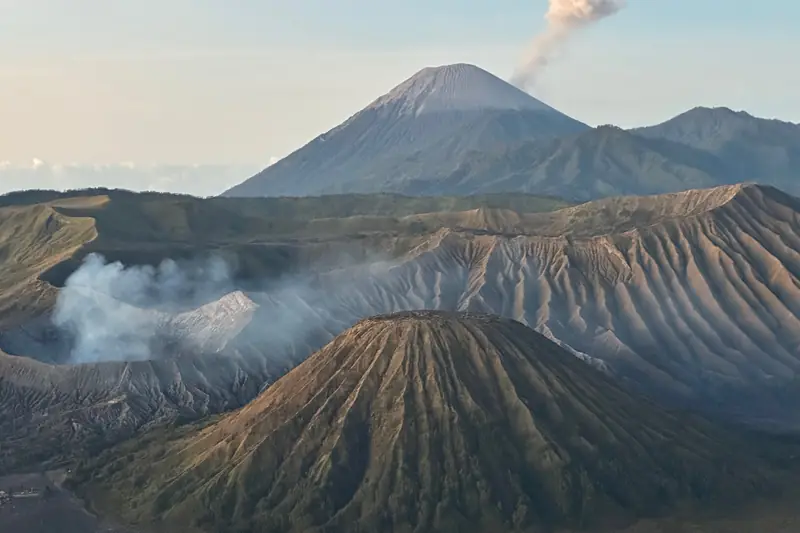
The lodge in front is the postcard. You sit on a deck at six in the morning and the mist boils up out of the Tengger caldera below you, slow and slate-coloured, and Bromo and its three sister-peaks emerge from it in succession, the way three figures in a fog might emerge: not at once, but in order, oldest first. The sun comes up over the eastern rim. The light moves down the slopes. The mist starts to break apart. You drink coffee out of a small ceramic cup. There are people who have flown from Frankfurt for this, and they are taking it very seriously, with tripods. There are also a dozen Indonesian honeymooners taking selfies. Both are correct.
The cabin behind is the secret. The night I spent there, the sky was clear in a way I had not seen since New Zealand four years earlier — the Milky Way, the actual band of it, with the visible bulge of the galactic centre running across the sky like a stain. I sat outside on the deck after midnight, in a sweater I had not packed enough of, with a cup of ginger tea, and watched it. The cabin’s lights were off. The caldera was a kilometre below me and invisible. I could see, by starlight, my own hand.
The next morning we drove down to the caldera floor, which is grey volcanic sand stretching for several kilometres in every direction. The locals call it the Sea of Sand, and that is the right description; it is flat and grey and the wind moves across it in small loose currents. In the centre of the Sea of Sand is the cone of Bromo itself, a perfect grey cone with steam pouring continuously from the lip. You climb it in stages: ride across the sand to the base, walk up an ash slope, then a stairway, then the lip. From a distance Bromo is beautiful. Up close, Bromo is sulfur. The wind comes off the lip in slow burning gusts. It is the smell of every chemistry classroom you have ever been in, magnified to the size of a country. Your eyes water. Your shirt smells like it afterwards, and continues smelling like it long after you have washed it.
At the base of the climb, in the parking area where the horses wait, there were Tenggerese vendors selling bundles of edelweiss flowers. The flowers were sacrificial. You climbed the cone, you walked to the lip, you tossed your edelweiss into the crater, and Bromo — in theory — was appeased. Every car that came down from the climb was lighter than the car that had gone up by a few small bundles of dried flowers.
I bought three bundles. I tossed two over the edge. The third I kept. I also bought, from a woman at the parking area, a small teddy bear made entirely of dried edelweiss flowers. I do not know who decided that an offering to a volcano god could also reasonably be a child’s toy. I do not know whether the teddy bear is supposed to be a gift to the volcano, a gift from the volcano, or simply a category of object that exists at the intersection of sacrifice and souvenir. I bought the teddy bear because I did not believe I would ever see another one. I have not. It is at home, on a shelf, and it smells faintly of dried flowers and faintly of sulfur, which is the smell of the whole country compressed into a stuffed animal.
The hike up is harder than people say. It is not the altitude. Bromo’s lip is only about 2,300 metres. It is the slope and the loose footing and the fact that, by the time you arrive at the lip, you have been smelling sulfur for twenty minutes and your eyes have been watering for the last ten and you can hear, from inside the cone, a low continuous hissing that is the kind of sound the planet makes when it is doing actual planet things, just out of sight.
I stood at the lip for as long as my eyes could take. I tossed the edelweiss. I came back down.
Ijen, the next morning, was a different thing again. You do not drive up Ijen during the day. The reason you do not drive up during the day is that the thing you go to Ijen to see — the blue flames — are only visible at night, and only just before dawn, when the sulfur gases inside the crater catch fire as they hit the air and burn an unearthly electric blue against the inside of the crater wall.
To see this, you start the climb at two in the morning. You park at a trailhead at altitude. You walk up, by headlamp, in a long slow procession of mostly silent strangers, for about ninety minutes. The trail is not technical but it is steep, and at this hour and altitude there is no point pretending you are walking quickly. You hear, before you see, the miners. They go past you on the way down in twos and threes, with the wicker baskets I mentioned at the start of this article, full of broken yellow stone, balanced across their shoulders on a bamboo pole. They have been at the crater since midnight. They will do this trip twice more before sunrise. The baskets weigh, on average, about seventy kilograms. The men carrying them weigh, on average, about sixty.
At the top of the trail, you turn down a separate path into the crater itself. The path is steeper than the main trail, in places it is more or less a scramble down loose rock, and you arrive at the lip of an inner valley which contains an enormous turquoise lake. The lake is the colour of certain commercial swimming pools, except that it is also the most acidic body of water on the planet. The pH is somewhere under one. If you fell in, your clothing would dissolve before you did, but only just.
The blue flames are at the lake’s edge, where the sulfur seeps come up out of the rock. They are blue in the way a gas stove is blue, and they move in slow curling sheets, and they are silent. The miners work around them. They wear hard hats and bandanas over their mouths but very little else for protection from the gases, which are continuously and visibly billowing out of the same vents that are producing the flames. You stand on a rock and you watch them. There is nothing to be done with what you are watching. It is the most beautiful, the most surreal, and the most morally uncomfortable thing I have seen in any country.
The sun comes up over the rim of the outer crater. The flames disappear into the pale blue of dawn. The lake turns a brighter turquoise. The cooled lava paths from previous eruptions become visible all the way down the outer slopes, carving deep streaks of black through the green — a record of what this mountain has done before, written in the only handwriting it has. You climb back out.
It was on the way down, on the outer trail, that I hurt my knee. Not seriously. I had stepped on a loose rock with my full weight in the dark and felt something twinge, and the descent was suddenly slower than the ascent. I sat. The miners went past me, downhill now, the baskets emptied of sulfur and refilled with their water bottles and lunchboxes. One of them stopped. He reached inside his shirt and produced a small sulfur sculpture, which he had clearly carved that morning at the lip of the crater during a break. It was a sea turtle. He named a price that I would have called fair in any country. I paid him. He moved on.
Several more passed me with similar offers — a small whale, an elephant, a face I could not identify. I bought the turtle and politely declined the others. They were unfailingly polite about the refusal.
And then, eventually, came the Lamborghini.
There is, on the long trail back from the crater to the parking lot, a small economy of men with wooden carts who will, for a fee, push you back down. The carts are flagged with painted racing stripes. They are uniformly named for European sports cars. There is, somewhere out there, an Ijen Ferrari. I am told there is a Maserati. I never saw the Bugatti but I am open to the possibility. The men who push them are the porters I mentioned earlier — a guild distinct from the miners, working the same trail in a parallel rhythm. The miners had passed me with sulfur sculptures during their break. The porters had now arrived with the carts.
I declined the Lamborghini. The Australian woman in the cart that passed me twice — going both directions on the same descent — looked, the second time, like she had become reconciled to her decision. I waved. She waved back, a small wave with the kind of face that said I know. The Lamborghini went past at a brisk and slightly alarming pace. The man pushing it was smiling. He had two more runs in him before lunch.
I sat in the parking lot at the bottom of Ijen, drinking thick sweet coffee out of a paper cup that one of the Lamborghini drivers had offered me, and watched the day start properly. The miners I had been watching at the crater were sitting on plastic stools across the lot, eating instant noodles out of styrofoam bowls, comparing what they had carried that night. The tourists were piling into vans heading west toward the ferry to Bali. The vans had brand names on them. The stools did not.
Indonesia is in the middle of doing something with itself that I am not the right person to assess. Tourism is becoming, by official policy, one of the largest sectors of the economy. Bali has been at capacity for years. The country has been told, more or less explicitly, that the rest of the archipelago is supposed to absorb the overflow. Java was the first to feel it. Yogya, Bromo, Ijen — these are places that ten years ago had a fraction of the foot traffic they have now, and ten years from now will likely have more again. Some of the people I met clearly liked this. Some clearly did not. The men with the Lamborghinis are making more money than their fathers did. The waterfall guides at Madakaripura are walking the same twenty minutes ten times a day. The teddy bear vendor at the base of Bromo will probably, by the time anyone reads this, have a stall twice as large. I am not going to tell you what the right amount of this is. I do not know. The country is making the decision in real time, by the millions, in a series of small bets at parking lots and trailheads and gado gado stalls — and what I saw in two weeks of looking is what I saw, which is not a verdict.
What I will say is that East Java, right now, in 2026, is a place that has not yet finished becoming whatever it is going to become. The big monuments are old and settled. The volcanoes will do what volcanoes do. But everything else — the towns along the road, the relationships between miners and tourists, the way Yogya is filling up while Jakarta is sinking — is still being decided. If you go now, you see the decision in progress.
I came home with a teddy bear, a sulfur sea turtle, and a pair of shoes I had to throw out because they would not stop smelling like a struck match. The teddy bear is on a shelf. The turtle is on a desk. The shoes are gone. The country is still there, deciding.
Fly into Yogyakarta. Spend three days. Go to Borobudur at sunrise on a weekday before the buses arrive, and to Prambanan in the late afternoon when the light is long and the carvings hold shadow. Walk in the city after dark. Accept the chess invitation. Tip the gado gado stand even if she refuses, and especially because she refuses. Eat soto ayam at least twice; the second bowl is always better than the first. Drive east in daylight, not overnight; the in-between is the country. Stop at Madakaripura even if it is not on the itinerary — especially if it is not on the itinerary. Sleep one night at the front of Bromo for the sunrise, and one night at the back for the stars. Buy an edelweiss bundle and throw most of it in the crater. Climb Ijen at two in the morning; the lake at dawn is worth the headlamp. Buy a sulfur sculpture from the miner who offers you one, even if you would not otherwise. Decline the Lamborghini if your knees are good. Wave to the Australian.
And come soon. The capital is moving. Yogya is filling up. The miners are still mining. The teddy bears are still being made. None of these things will be exactly the same in five years. The volcanoes will be.